Christy Lynn

As reaches all-time highs and continues to go through price action swings, it has been attracting a lot of attention. As unknowing, new supporters of Bitcoin enter the cryptocurrency craze, this has presented ideal opportunities for Bitcoin scams to occur. Everyday investors are getting scammed by old, and new tactics. It’s important to note that although Bitcoin itself is not a scam, some tactics around it being bought and sold are. This article is to help shed some light on the current scams in the market to help you and your fellow investors avoid them. These scams aren’t limited to Bitcoin though; keep in mind that these schemes can apply to other cryptocurrencies and altcoins as well.
Quick answer: The most common Bitcoin scams in 2026 are “pig butchering” investment scams that start as friendly messages or romance, impersonation scams where fake support agents from Coinbase or other companies ask you to move funds, fake giveaways and AI deepfake videos of celebrities, crypto ATM scams targeting older adults, address-poisoning tricks, and fake “fund recovery” services. The golden rules: never share your recovery phrase, never send crypto to someone you met online, and verify every request through official channels.

Bitcoin Scam #1: Instagram Scams
Social media has become a scam haven for hackers and nefarious thieves. Sliding in the DMs has become increasingly common, and with automated bot technology, scammers are able to message hundreds (if not, thousands) of users per day waiting for the right victim to respond. Below are some common Instagram scams to stay alert to!
Sliding in the DMs
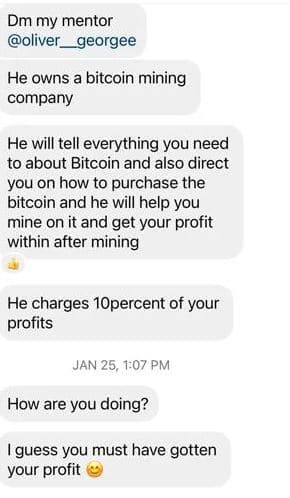
Direct message scams accounted for over 37% of total fraud on social media according to the Federal Trade Commission. In this scam, the scammer will DM you telling you to DM their “friend” or business partner about an investment opportunity. To avoid this scam, you should block and report these accounts immediately. Keep in mind this scam is also prevalent on Facebook and Telegram.

Keep your keys offline with a Ledger
- Stops phishing and malware from moving your coins
- Supports thousands of coins and tokens
- Works with phone and desktop
Buy only from the official store. Affiliate link. Compare hardware wallets
Bitcoin Scam #2: Cash App Bitcoin Scams
Cash App is a legitimate service. However, scammers commonly ask victims to use Cash App to send them money. Scammers will commonly ask users to share login details in order to deposit funds. NEVER share your login or password info. One of the most common Cash App scams is the “money-flipping” scam. In this scam, the thief will promise to double or triple your money if you send them a certain amount. An example would be that the scammer will send you screenshots and videos of other people who they have “helped” by doubling and tripling their money. Avoid this scam by NOT sending money to someone you don’t know. Sometimes, however, a scammer will hack a friend or family member’s social media account (Facebook, Instagram, etc) and ask all their connections to send them money. If a friend or family member ever asks you for money, ALWAYS verify this by directly calling them to verify their need.
Bitcoin Scam #3: Fake Bitcoin Exchanges
Bitcoin has increasingly become more popular, and because of this, fake exchanges have been popping up. These fake exchanges can come in two forms. The first is simply offering “too-good-to-be-true” prices on cryptocurrency. These scammers set up authentic-looking websites and steal money from users. The other type of fake exchange is when a reputable website, such as Coinbase, gets copied identically with the only change being its URL. Unknowing traders may see this site as authentic but should check the URL closely to ensure they are on the authentic website. Please be sure to only use reputable exchanges when trading Bitcoin!
Bitcoin Scam #4: Ponzi Schemes
A Ponzi Scheme is a fraudulent investment operation where the returns made on investments are paid by new investors and not returns on legitimate trades. The new people putting money in are actually rewarding the previous investors. This cycle continues as the scheme grows. Those new investors receive a return unknowingly through the introduction of new investors. Eventually, there isn’t enough new money coming in to cover the returns on the previous investors. This scheme only realistically rewards the creators of the Ponzi and will eventually collapse, causing many “new” investors to lose their money. By its design, it’s impossible for it to sustain itself, at the expense of all the investors. Examples of Ponzi schemes in the Bitcoin (and general cryptocurrency) space are endless. You are bound to come across people promising to grow your investment by double or more in a matter of days. Always keep in mind, if something sounds too good to be true, it probably is.
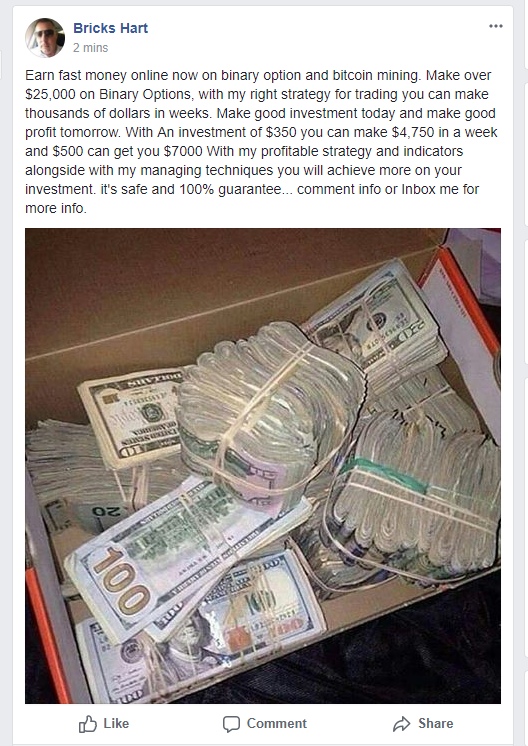
Here is an example of a Ponzi scam post, promising to insanely catapult your investment into another dimension of value. Once you send your money to this individual (which is a fake account by the way) you might as well kiss it goodbye.
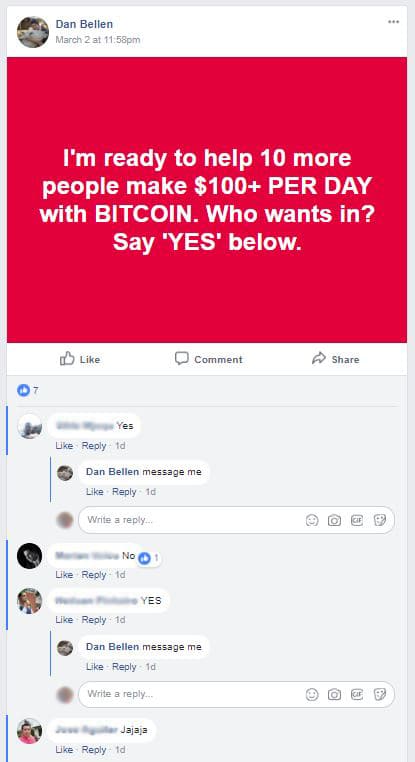
Here is another good example of a Ponzi scheme. I didn’t even capture the full comment thread of this post, but as you can see, MANY people are falling for these dirty tricks in hopes of making a quick buck. Oh, by the way, to the person who said “No” on this post:

BitConnect – The Ultimate Bitcoin Ponzi Scheme
Let’s talk about a real, widespread Ponzi Scheme that has since ceased operation. This scheme is BitConnect, which was initially based on Bitcoin fraud. BitConnect guaranteed returns on investment no matter how much you deposited into your account on their investment platform. Users would loan them their cryptocurrency that they would then use as capital to trade in the market and claimed they were able to generate a profit because they were trading on volatility within the market. According to BitConnect, they had developed software to handle the trading and this helped guarantee a profit, called Bitcoin price volatility software. They initially launched in 2016 promoting Bitcoin. Not long after launch, they had an initial coin offering for their own cryptocurrency called BitConnect Coin (BCC – not to be confused with Bitcoin Cash) which was used on their own platform for investment purposes. Users could buy BitConnect Coins with Bitcoin. They promoted their platform and drove tons of traffic to their website. The promotion was partly successful due to a multi-level referral program that paralleled that of a pyramid scheme. The referral program had three tiers. Users would gain benefits by inviting someone, and they also benefited from that person inviting someone, and then again if that person invited someone. BitConnect Coin found adoption on cryptocurrency exchanges due to demand. The system was working and generating returns for investors! This led to thousands of BitConnect users promoting their referral codes on social media. As the community grew, and with the launch of their cryptocurrency BitConnect Coin, they were generating returns for their users. However, as we discussed earlier, this is not sustainable. BitConnect reached a point where they recently shut down claiming it was due to constant bad press, denial of service attacks, and cease and desist letters. As you can expect, this leads to the Bitconnect platform collapsing as of January 18th, 2018. Although BitConnect was likely the first major Ponzi Scheme based on Bitcoin, it was likely not going to be the last. It is best to use common sense when getting involved with anything that sounds too good to be true or fraudulent. Anything that promises, or nearly guarantees a positive outcome (profit), should be looked at carefully. The old saying still remains relevant today, if it sounds too good to be true, it probably is. It is best to do thorough research and use your best discretion. The point I’d like to make is that Bitcoin was designed to be a self-sustaining decentralized digital monetary system, it wasn’t designed to make people rich. Bitcoin wasn’t created as a method for people to generate profit. People who intend to scam others out of their money will use whatever tools that are available to do so, whether that’s the Bitcoin technology, the scammy giveaways on social media, or email campaigns, people will use them to scam others. It is best to stay vigilant, especially anything that guarantees a positive return on investment.
Bitcoin Scam #5: Giveaway Scams
Giveaway and “imposter” scams have increased in popularity recently. These scams prey on the die-hard cryptocurrency communities and new investors. Fake social media accounts are popping up every day! These accounts are posing as staff members or company accounts for major cryptocurrency coins that announce they are doing a giveaway. Sounds great, right? All it takes to enter is to send a small amount of Bitcoin, or the chosen cryptocurrency, to a specific wallet address, and these staff members will be “giving back to the community” that has been supporting them all the way as a thank you! The accounts look legitimate and can use official headshots, company logos, banners, and sometimes even re-tweets of the official account they are posing as. Scammers are utilizing automated account creation tools that spawn tens or hundreds of duplicate accounts all set up the same or very similar ways. The tweet often requires a follow and re-tweet to help spread the giveaway. Add in the appropriate hashtags, start getting re-tweeted, multiply this by 10, 20, 50 duplicate fake accounts, and you can see how this scam can catch steam and be effective. But once you send your investments to these wallet addresses, you probably won’t see any kind of return.

The scam above claims to be from the “Stellar Development Foundation.” As you can see, the post looks fairly legitimate to the untrained eye. These scammers are obviously targeting group members who have at least “5 transactions history.” This preys on users who have cryptocurrency in their accounts, virtually guaranteeing a return for the scammer.

Above is an account claiming to be a known cryptocurrency exchange, Kucoin. Accounts like these feed on unknowing users spreading fake accounts for social media follows, impressions, and shares in order to maximize the potential of their scam. Giveaways may be legitimate and this is certainly not to say that there aren’t legitimate cryptocurrency giveaways out there. It is best to practice caution and not jump the gun. Be sure to verify tweets, Reddit posts, Facebook posts, or any kind of account claiming to be promoting a giveaway before sending any cryptocurrency to someone else’s wallet.
Bitcoin Scam #6: Initial Coin Offerings – ICOs
Anyone can create a cryptocurrency. Yes, even you or your brother living in your moma’s basement can create one. All you need is access to a computer and some basic design skills. What these scammers are doing is creating a web presence with a professional-looking website, quality infographics, whitepapers, and marketing their new and efficient protocol that will “revolutionize” an industry. Creating an ICO, or fake ICO is actually simple to do. You’re bound to come across them at one point or another.

This ICO was exposed as a scam when accidentally listing Ryan Gosling as their graphic designer. Looks like Ryan missed his true life’s calling. So, where does the scam actually come in? After their project has a professional-looking front, they’ll launch an Initial Coin Offering (ICO), and in order to buy some of their coins, you have to send them Bitcoin, or other cryptocurrencies in exchange. Say bye-bye to your investments. It is important to keep in mind that there are legitimate new projects that launch with an initial coin offering. However, it’s extremely important to do your due diligence when investing in a new project. Keep in mind that most ICOs will fail.
Bitcoin Scam #7: Illegitimate Desktop and Mobile Wallets
There has been an increase in fake Bitcoin/other cryptocurrency wallets popping up. These Bitcoin wallet applications for both desktop and mobile phones can steal the Bitcoin that you put in them. It’s scary, but almost anyone can create and upload a mobile app, and the same goes for desktop applications. It’s extremely important to vet and research the wallet before you download it. Be extra cautious of new wallets coming to market. For some extra assurance, you can check the number of downloads and reviews for the mobile app, and be sure to do some Googling to be as certain as you can that it is a trustworthy mobile or desktop wallet app. Many users have recently been asking if MetaMask is safe. MetaMask is a reputable software wallet that works as a browser extension to store your cryptocurrency. This is a safe choice as long as you’re using their recommended security best practices.
Bitcoin Scam #8: Browser Extensions
Let’s face it – almost all of us use browser extensions…And they are a privacy nightmare. These extensions range from adblockers to password managers, to almost anything you can think of. Browser extensions require permissions to run in your browser, and often times that includes the ability to read and write data on any website that you visit and read your computer’s clipboard (the copy-paste functionality build-in). It is entirely possible for a browser extension to read your login information for a website, and send it back to its servers. To help guard against this, it’s best to enable 2-factor authentication (2FA) on the exchanges you use to store your cryptocurrencies. While this does not completely prevent these scammers from accessing your account, it drastically increases the difficulty of doing so. Some exchanges, such as Binance, for example, have increased security measures by requiring a 2FA confirmation (once enabled) in addition to confirming a withdrawal by e-mail. It should be mentioned, that you should not use the same password on these cryptocurrency exchanges that you use to log in to your email account! As mentioned above, another vulnerability when it comes to browser extensions is the ability to read your computer’s clipboard. So, even if you follow all the right account precautions to keep your exchange accounts safe, extensions can read your computer’s clipboard if given permission when it was installed. This means that if you use a desktop wallet and copy the withdrawal key, it can be stolen by a third party and then used to withdraw your Bitcoin to commit fraud. This applies to anything you copy including wallet recovery seeds, backup codes, passwords, and more.
Bitcoin Scam #9: Online Seed Generators
In no way, shape, or form, should you use an online seed generator when creating Bitcoin wallet recovery seeds! A seed is used to generate a set of keys to access a wallet address. In some instances, no other information is needed to create public addresses without having to know the private key to do so. Basically, the key is extrapolated from a long single phrase known as the seed. There are websites online that target specific cryptocurrencies, such as Bitcoin, that allow a user to “randomly” generate a key for them. That key is then logged on their servers and can be used later to create the key that allows them to withdraw from your wallet. When you create your Bitcoin wallet, you need to keep your seed private, and ideally, offline, and in more than one location. It is common for people to save them in text files and place them on multiple flash drives that they keep in different locations. Redundancy is important in case a flash drive becomes corrupt or is lost.
New and growing crypto scams (2024–2026)
Pig butchering scams
Scammers build a friendship or romance over weeks through texts, dating apps or social media, then introduce a “can’t-lose” crypto investment on a fake platform. Your balance appears to grow until you try to withdraw, when they demand “taxes” or “fees.” This is now the costliest type of crypto fraud.
Fake support and impersonation calls
Criminals pose as Coinbase, your bank or even government agents and claim your account is compromised, urging you to move funds to a “safe” wallet. After a 2025 data incident at Coinbase, these calls became more convincing because scammers had some customers’ personal details. No legitimate company will ever ask you to move your crypto.
Crypto ATM scams
Scammers pressure victims, often older adults, to withdraw cash and deposit it into a Bitcoin ATM to “protect” their money or pay a fake fine. The FTC and FBI have issued repeated warnings, and some states now cap crypto ATM transactions.
Address poisoning
Attackers send tiny transactions from wallet addresses that look almost identical to ones you use, hoping you’ll copy the wrong address from your history. Always verify the full address before sending.
AI deepfakes and fake giveaways
Deepfake videos of celebrities or company founders promote “double your bitcoin” giveaways or trading bots. Real giveaways never require you to send crypto first.
Wallet drainers and fake airdrops
Malicious sites and “free mint” links trick you into signing transactions that empty your wallet. Only connect your wallet to sites you trust, and review what you’re signing.
Fund recovery scams
After you’ve been scammed, “recovery experts” promise to get your crypto back for an upfront fee. They can’t. They’re a second scam.
Case study: SafeMoon
SafeMoon was one of the most hyped tokens of 2021, promoted with promises of “reflections” (automatic rewards for holders) and a liquidity pool that was supposedly locked. In reality, executives could access that liquidity and used millions of dollars of investor funds for personal spending, including luxury homes and cars.
- 2023: the SEC and Justice Department charged SafeMoon’s leaders with fraud, and SafeMoon filed for Chapter 7 bankruptcy in December.
- May 2025: CEO Braden Karony was convicted of securities fraud, wire fraud and money-laundering conspiracy.
- February 2026: he was sentenced to 100 months in prison.
Lessons: be skeptical of tokens that promise automatic passive income, claim liquidity is “locked” without independent proof, or rely on celebrity and social-media hype. If you held SafeMoon, check the Justice Department’s victim notification resources for any restitution updates.
What to do if you’ve been scammed
- Stop sending money and cut off contact.
- Move any remaining funds to a new wallet with a new recovery phrase.
- Report it to the FBI at ic3.gov, to the FTC, and to the exchange you used.
- Keep records of addresses, transaction IDs and messages.
- Ignore anyone offering to recover your funds for a fee.
In Summary
When it comes to participating in giveaways that require payment, investing in brand-new coins, installing browser extensions, and using desktop and mobile wallets, be extremely cautious. Do as much research as you can until you’re confident you can trust what you’re about to use. There are legitimate services and software out there, you just need to take the time to weed out the possible scams.
Free masterclass
Learn crypto the right way.
Christy Lynn’s free beginner course, straight to your inbox. Plain English, never spammy.

Join free and get one 5-minute lesson in your inbox every 1–2 days:
✅ What crypto actually is, in plain English
✅ The 5 safety rules that protect your money from scams
✅ Where to buy, and exactly how to invest your first $100
✅ How to store your crypto safely and earn staking rewards
✅ How to research coins and handle crypto taxes
No hype, no spam. Unsubscribe anytime.
Frequently asked questions
What is the most common crypto scam?
Investment scams, especially pig butchering, cause the largest losses, followed by impersonation and fake support scams.
Can stolen bitcoin be recovered?
Rarely. Blockchain transactions are irreversible, though law enforcement sometimes seizes funds from scammers. Report losses to ic3.gov quickly.
How can I tell if a crypto platform is legit?
Check that it’s licensed where you live, search for independent reviews, and be wary if withdrawals are blocked or require extra fees. See our list of the best crypto exchanges.