Christy Lynn
Staking lets you earn rewards on Ethereum you already own by helping secure the network. Since Ethereum moved to proof of stake in 2022, staking has become one of the most popular ways to put ETH to work, and today you can stake through an exchange, a liquid staking protocol, your own hardware wallet or even an ETF. We compared the best ways to stake ETH in 2026 on rewards, fees, risk and ease of use.
Quick answer: The best way to stake Ethereum for most beginners is an exchange such as Coinbase or Kraken, where you can stake any amount in a few taps. If you want to keep control of your ETH, Lido (stETH) and Rocket Pool (rETH) are the leading liquid staking options; Lido’s 7-day average rate was about 2.2% a year after fees in early October 2026. Expect roughly 2% to 3% a year in ETH, minus platform commissions. Rewards aren’t guaranteed, ETH’s price can fall far more than you earn, and staking rewards are taxable income in the US.

Coinbase: easiest way to stake ETH
- Stake ETH in a few taps
- Boosted rewards with Coinbase One
- Public, US-regulated company
Staking isn’t available in every state. Rates change and aren’t guaranteed. Affiliate link.
Staking rates change daily. Rates and availability were checked in October 2026 and vary by platform and US state.
Best Ethereum staking options compared
| Option | Best for | Highlights | |
|---|---|---|---|
| Coinbase Easiest | Beginners | Stake any amount; Coinbase One boosts rewards | Stake on Coinbase |
| Kraken Best exchange value | Regular stakers | Flexible and bonded staking in most US states | Visit Kraken |
| Gemini Security-focused | Cautious investors | ETH staking from a New York trust company | Visit Gemini |
| Lido (stETH) Best liquid staking | Self-custody users | Stake any amount from your wallet; 10% fee on rewards | |
| Rocket Pool (rETH) Most decentralized | Decentralization fans | Liquid staking spread across independent node operators |
| Method | Minimum | Who holds your ETH | Can you exit quickly? | Main risk |
|---|---|---|---|---|
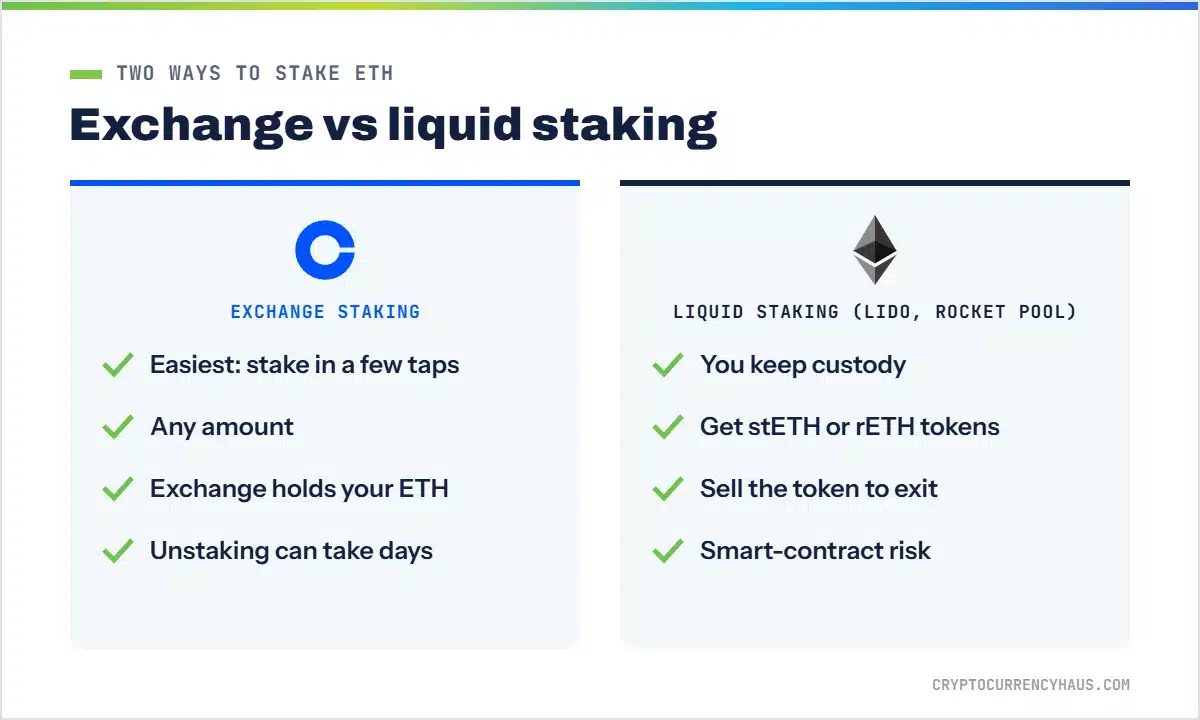
| Exchange staking | Any amount | The exchange | Usually, but unstaking can take days or weeks | Platform risk |
| Liquid staking (Lido, Rocket Pool) | Any amount | You (via a token) | Yes, by selling the token | Smart-contract and price-gap risk |
| Hardware wallet staking | Varies by provider | You | Depends on the provider | Provider and setup risk |
| Solo staking | 32 ETH | You | Exit queue can take days or weeks | Technical and slashing risk |
| Staking ETFs | One share | The fund | Yes, by selling shares | Fund fees and price risk |
How Ethereum staking works
Ethereum uses proof of stake: validators lock up ETH and take turns proposing and checking blocks. In return, they earn newly issued ETH plus a share of transaction fees. Running your own validator requires 32 ETH and a computer that stays online, so most people stake through a service that pools ETH and runs validators for them, keeping a commission on the rewards.
Rewards depend on how much ETH is staked across the whole network and how busy the network is. When more ETH is staked, each staker earns a slightly lower rate. Validators that break the rules or go offline can be penalized, a process called slashing, which is one reason to choose experienced operators. Learn the basics in what is staking.
The best ways to stake ETH
1. Coinbase: easiest for beginners
Coinbase lets you stake ETH with a few taps in its app, with no minimum and rewards shown in your balance. It also offers cbETH, a liquid staking token you can move or use elsewhere. Coinbase keeps a commission on rewards, and Coinbase One members get a staking boost of +5% to +15% depending on their plan.
- Pros: simplest setup, any amount, public US company, Coinbase One boost.
- Cons: commission reduces your rate, not available in every state, Coinbase holds your ETH.
2. Kraken: best exchange value
Kraken offers ETH staking alongside more than 20 other stakeable assets, with flexible and bonded options. After pausing US staking in 2023, it relaunched for US customers in 2025, though it isn’t available in states such as California, New Jersey, New York and Washington.
- Pros: broad staking menu, strong security record, low trading fees on Kraken Pro.
- Cons: excluded in several large states, Kraken holds your ETH.
3. Gemini, Crypto.com and Robinhood: good if you already use them
Gemini offers ETH staking with no minimum from a regulated New York trust company. Crypto.com supports ETH staking in its app, and Robinhood customers in the US can stake ETH directly in the Robinhood app. Commissions and state availability vary, so compare the rate shown in each app.
- Pros: convenient if your ETH is already there.
- Cons: rates are often lower after commissions; availability varies by state.
Visit Gemini Visit Crypto.com Visit Robinhood
4. Lido (stETH): best liquid staking
Lido is the largest liquid staking protocol. You stake any amount of ETH from your own wallet and receive stETH, a token whose balance grows daily as rewards arrive. You can hold it, sell it or use it in DeFi while it keeps earning. Lido charges a 10% fee on rewards, and its 7-day average rate was about 2.2% a year after fees in early October 2026.
- Pros: keep custody, any amount, exit anytime by selling stETH, widely supported.
- Cons: smart-contract risk, stETH can trade slightly below ETH in stressed markets, Lido’s large share of staked ETH raises centralization concerns.
5. Rocket Pool (rETH): most decentralized
Rocket Pool spreads staked ETH across many independent node operators, which many in the Ethereum community prefer for decentralization. You receive rETH, a token that rises in value against ETH as rewards accrue, rather than growing in balance.
- Pros: more decentralized, keep custody, rETH works across DeFi.
- Cons: smart-contract risk, smaller liquidity than stETH, slightly more complex.
6. Your hardware wallet: best for security-minded holders
You can stake directly from a hardware wallet through its companion app: Ledger Wallet connects to staking providers, and Trezor Suite supports ETH staking through a partner. Your keys never leave the device, though you rely on the staking provider and its terms. See our Ledger Nano X review and Trezor Safe 5 review.
- Pros: keys stay offline, no exchange risk.
- Cons: minimums and fees vary by provider; more steps than exchange staking.
Shop Ledger Nano X Shop Trezor Safe 5
7. Solo staking and staking ETFs: for specific needs
Solo staking means running your own validator with 32 ETH. It earns the full reward with no commission and is best for the network, but requires technical skill and reliable hardware. At the other end, some US spot Ether ETFs now stake part of their holdings and pass rewards to shareholders after fees, which lets you get staking exposure in an ordinary brokerage account. Check each fund’s prospectus for its staking policy and fees.
- Solo staking: full rewards and control, but 32 ETH and technical work.
- Staking ETFs: simple and IRA-friendly, but you don’t hold ETH directly and pay fund fees.
How much can you earn staking ETH?
Ethereum staking rewards have been around 2% to 3% a year recently. After fees and commissions, most platforms pay somewhat less than the network rate. For example, if you stake 2 ETH at 2.2%, you’d earn about 0.044 ETH over a year. Its dollar value depends entirely on ETH’s price, which can swing far more than 2% in a single day.
Be skeptical of any platform promising much higher fixed yields on ETH. In 2022, lenders such as Celsius and BlockFi advertised high “yield” and then froze customer funds. Read what is APY in crypto and is staking crypto safe?
Risks of staking ETH
- Price risk: ETH’s price can fall far more than the rewards you earn.
- Exit delays: when many people unstake at once, Ethereum’s exit queue can stretch to days or weeks.
- Platform and smart-contract risk: an exchange could fail, or a liquid staking contract could be exploited.
- Slashing: poorly run validators can lose part of their stake.
- Liquid token price gaps: stETH or rETH can trade below the value of the ETH behind them in stressed markets.
- Taxes: in the US, staking rewards are ordinary income when you receive them. See our crypto tax guide.
How to stake Ethereum in 4 steps
- Choose a method: an exchange such as Coinbase or Kraken for simplicity, or Lido or Rocket Pool if you want to keep custody.
- Buy ETH or transfer ETH you already own. See how to buy Ethereum.
- Opt in to staking and review the commission, estimated rate and unstaking time before you confirm.
- Track your rewards and keep records for taxes. Tools such as Koinly import staking rewards automatically.
How we chose the best ETH staking options
We compared each option’s published fees, rates, minimums, custody model, unstaking process, US availability and track record. Rates are snapshots and change constantly. Partners can’t pay for our rankings. Read our review process.
The bottom line
For most beginners, staking ETH on Coinbase or Kraken is the simplest path, and Coinbase One can boost your rewards. If you’d rather keep custody, Lido and Rocket Pool let you earn while holding a liquid token, and hardware wallet staking keeps your keys offline. Whichever you choose, expect modest rewards of a few percent a year, only stake ETH you plan to hold anyway, and keep good tax records. Compare other coins in the best crypto staking platforms.
Coinbase: easiest way to stake ETH
- Stake ETH in a few taps
- Boosted rewards with Coinbase One
- Public, US-regulated company
Staking isn’t available in every state. Rates change and aren’t guaranteed. Affiliate link.

Kraken: staking in most US states
- ETH plus 20+ stakeable assets
- Flexible and bonded options
- Security record since 2011
Not available in every state. Affiliate link. Read our Kraken review
Frequently asked questions
What is the best way to stake Ethereum?
For beginners, an exchange such as Coinbase or Kraken is easiest. For self-custody, Lido and Rocket Pool are the leading liquid staking options.
How much can I earn staking ETH?
Recently about 2% to 3% a year, minus fees. Lido’s 7-day average was about 2.2% after fees in early October 2026. Rates change and aren’t guaranteed.
Do I need 32 ETH to stake?
Only to run your own validator. Exchanges and liquid staking protocols let you stake any amount.
Can I unstake my ETH at any time?
You can request it, but unstaking can take days or weeks when Ethereum’s exit queue is busy. Liquid staking tokens like stETH can be sold anytime, though the price may differ slightly from ETH.
Is staking ETH safe?
Staking with reputable platforms is relatively safe, but you face price, platform, smart-contract and slashing risks. Never stake more than you’re prepared to hold long term.
Are ETH staking rewards taxable?
Yes. In the US, staking rewards are ordinary income when you receive them, and you may owe capital gains tax when you sell.
What is stETH?
stETH is Lido’s liquid staking token. It represents staked ETH and grows in balance as staking rewards are added.