Christy Lynn
An envelope (or an email) from your crypto exchange with “Form 1099-DA” on it can look alarming, especially when the number in the proceeds box is bigger than anything you think you made. Here’s what the form is, what each box means, and how to report it without paying tax on money you never earned. It’s one part of our crypto tax guide for US investors.
Quick answer: Form 1099-DA is the IRS form US crypto exchanges use to report your crypto sales, trades and spending to you and the IRS. It started with 2025 transactions, and those forms show what you received but usually not what you paid. For 2026 sales, brokers must also report cost basis, but only on crypto bought on that same platform since January 1, 2026. Proceeds aren’t profit. You report each sale on Form 8949 with your real cost basis.
IRS rules on this page were checked on October 28, 2026 against the IRS instructions for Forms 1099-DA, 8949 and Schedule D. This is education, not tax advice. If your situation is complicated, talk to a CPA or enrolled agent.
What is Form 1099-DA?
Form 1099-DA, “Digital Asset Proceeds From Broker Transactions,” is an information return. Your broker files one copy with the IRS and sends one to you. It works like the Form 1099-B you get from a stock brokerage, except it’s built for crypto, stablecoins and NFTs.
“Broker” here mostly means custodial platforms: US exchanges and apps that hold your crypto for you, such as Coinbase, Kraken, Gemini or Robinhood, plus some crypto payment processors. According to the IRS, you’ll get a 1099-DA when a broker handles any of these for you:
- Selling crypto for dollars or another currency
- Trading one coin for another, including swaps into a stablecoin
- Spending crypto on goods or services through the platform
- Paying the broker’s own transaction fees with crypto
Brokers must get the form to you by February 15 of the year after the sale, or the next business day if that date falls on a weekend or holiday. February 15, 2027 is Presidents’ Day, so forms for 2026 sales are due by February 16, 2027. Look in your exchange’s tax documents section. You don’t attach the 1099-DA to your return. You use it to fill in Form 8949, and the IRS uses its copy to check that your return matches.
What will your 1099-DA show for 2025 and 2026 sales?
This is where most of the confusion comes from. The rules phase in, so the same coin can show up very differently depending on when you bought it, where you bought it and when you sold it.
| Your sale | What the form shows | What you do |
|---|---|---|
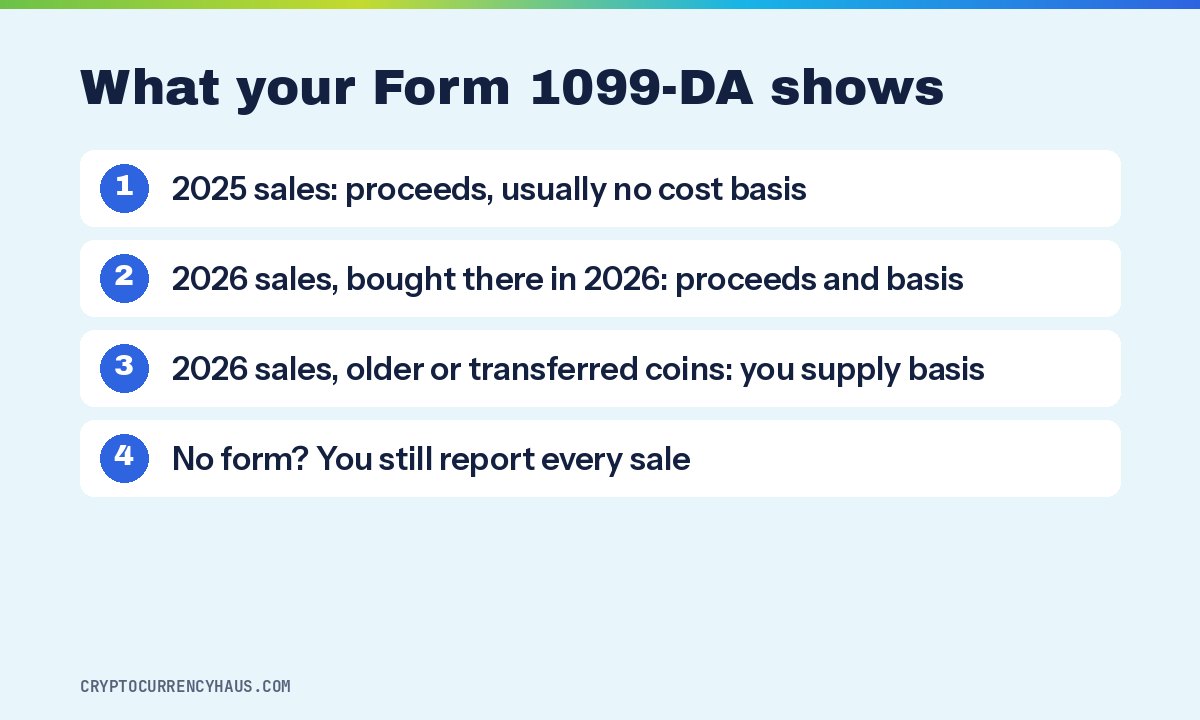
| Any sale in 2025 | Proceeds; cost basis usually missing (optional for brokers) | Supply your own basis on Form 8949 |
| 2026 sale of crypto bought on the same platform on or after Jan 1, 2026 and never moved (“covered”) | Proceeds and cost basis (required) | Check it against your records |
| 2026 sale of crypto bought before 2026, or transferred in (“noncovered”) | Proceeds; box 9 checked; basis often missing | Supply your own basis |
| Stablecoin sales of $10,000 or less for the year at one broker | May not be reported (optional de minimis rule) | Still report any gain or loss |
Two words do a lot of work in that table. A covered digital asset is one the broker can fully track: you acquired it in your account there after 2025 and it stayed in that account until you sold. Everything else is noncovered. If you bought Bitcoin on Coinbase in 2021 and sell it in 2026, it’s noncovered, and Coinbase doesn’t have to tell the IRS what you paid.
That doesn’t mean your old coins are tax-free. It means the burden of proving your cost basis stays with you. And if you sell old and new coins in one trade, the IRS tells brokers to split it: one form for 2026 covered coins and a separate one for the older noncovered coins. Getting several 1099-DAs from one exchange is normal.
What do the boxes on Form 1099-DA mean?
You don’t need to understand every box. These are the ones that decide what goes on your return.
| Box | What it means | What to check |
|---|---|---|
| 1a, 1b | Code and name of the asset (for example Bitcoin) | That it’s a coin you actually sold |
| 1c | Number of units sold | Matches your transaction history |
| 1d | Date acquired (can be blank) | Decides short-term vs long-term |
| 1e | Date sold or disposed | The tax year it belongs to |
| 1f | Proceeds, after transaction fees | Not profit. This is what you received |
| 1g | Cost or other basis | Blank or $0 on coins you paid for is a red flag |
| 1i | Wash sale loss disallowed | Only used for tokenized stocks and securities, not regular crypto |
| 2 | Checked if basis was reported to the IRS | Decides which Form 8949 box you use |
| 4 | Federal income tax withheld | Normally $0 (see the W-9 section below) |
| 6 | Short-term or long-term gain or loss | Matches how long you really held it |
| 8 | Broker used lot choices you gave it | Matches the lots you picked |
| 9 | Checked if the asset is noncovered | If checked, basis is likely missing |
| 12a, 12b | Units transferred in, and the transfer-in date | Your clue to find the original purchase |
There’s also an “Applicable checkbox on Form 8949” with a letter code (G, H, J, K or Y). It tells you which Form 8949 box to use, and we map each one below.
One detail matters more than it looks. The IRS tells brokers to leave box 1g blank when they aren’t reporting basis, and to enter $0 only when the basis really was zero. A blank box means “work it out from your records.” A $0 tells the IRS your entire sale was profit. Kraken’s tax help center says the same: when it doesn’t know your cost, it reports the sale without a basis, and a blank shouldn’t be read as $0. If you see $0 next to coins you paid real money for, fix it on Form 8949.
Why does my 1099-DA show no cost basis, or $0?
Usually because the coins moved. An exchange only knows what you paid for crypto you bought on that exchange. Send coins in from another app or a hardware wallet, and the receiving exchange sees them arrive with no purchase price attached. Boxes 12a and 12b show how many units came in and when, which tells you where to look for the original purchase.
Here’s how that plays out with real numbers:
- In March 2026 you buy 0.1 BTC on Exchange A for $8,000, including fees.
- In May you send it to Exchange B because you like its app better. Moving crypto between your own accounts isn’t taxable.
- In November you sell the 0.1 BTC on Exchange B and receive $9,000 after fees.
- Exchange B’s 1099-DA shows $9,000 in box 1f, box 9 checked (noncovered, because the coins were transferred in), 0.1 in box 12a, the May date in box 12b, and no basis.
Your real gain is $1,000 ($9,000 minus $8,000), held under a year, so it’s short-term. If you copied the form and used zero basis, you’d report a $9,000 gain. In the 22% bracket that’s roughly $1,980 of federal tax instead of about $220. Your Exchange A purchase records are what close that gap, so download them before you close any old account.
Some exchanges now help with this. Kraken’s Tax Center, for example, shows a “Resolve Missing Cost Basis” banner when it finds sales without a basis. Since January 1, 2025, the IRS also wants cost basis tracked separately for each wallet and account rather than pooled across all of them (Rev. Proc. 2024-28). Our crypto tax guide explains what that change means. It’s another reason a 1099-DA from one exchange rarely tells the whole story.
How do you report Form 1099-DA on your tax return?
Every sale on the form goes on Form 8949, and the totals flow to Schedule D of your Form 1040. Digital assets get their own checkboxes on Form 8949. The IRS says not to use boxes C or F for them.
| Form 8949 box | Use it when |
|---|---|
| G (short-term) or J (long-term) | You got a 1099-DA and basis was reported to the IRS (box 2 checked) |
| H (short-term) or K (long-term) | You got a 1099-DA but basis was not reported to the IRS |
| Code Y on the form | The broker didn’t know your holding period. Use H or K based on your own records |
| I (short-term) or L (long-term) | You sold crypto and didn’t get a 1099-DA for it |
For the transferred Bitcoin in the example above, the Form 8949 line would look like this:
| Form 8949 column | What you enter |
|---|---|
| Checkbox | H (short-term, basis not reported) |
| (a) Description | 0.1 BTC |
| (b) and (c) Dates | 03/2026 purchase date, 11/2026 sale date |
| (d) Proceeds | $9,000 (from box 1f) |
| (e) Cost or other basis | $8,000 (from your Exchange A records) |
| (h) Gain or loss | $1,000 |
Then follow these steps:
- Collect every form. Download the 1099-DA from each exchange you used, plus any 1099-MISC for rewards. One exchange’s form never covers another’s.
- Pull your full history. Export the transaction history (CSV) from every exchange and wallet, including ones you no longer use. That’s where your purchase prices live.
- Match each sale to its purchase. For transferred coins, use boxes 12a and 12b to find the original buy on the old platform. That’s your basis.
- If basis was reported but is wrong (boxes G or J): enter the basis exactly as the form shows in column (e), put code B in column (f), and correct it with an adjustment in column (g), as the Form 8949 instructions describe.
- If basis wasn’t reported (boxes H or K): enter your correct basis in column (e).
- Total it up. Carry the Form 8949 totals to Schedule D, and answer “Yes” to the digital asset question on page 1 of Form 1040. If every sale had basis reported to the IRS and needs no changes, the Schedule D instructions let you skip Form 8949 and enter the totals on line 1a or 8a.
- Keep the proof. Save the exports and your purchase records. If the IRS asks why your basis differs from the 1099-DA, those files are your answer.
If you made a handful of trades on one exchange, you can do this by hand or in a tax app like TurboTax. Past 20 or 30 transactions, or with coins spread over several platforms, crypto tax software earns its fee. It imports every account and matches transfers, so moved coins keep their original basis. Then it produces a finished Form 8949. Koinly, for example, says you can import and preview your gains for free and pay only when you download the reports.
What if your 1099-DA is wrong?
The IRS’s own advice is short: ask the company that issued it for a corrected form (its name and contact details are in the “Filer” box at the top left), keep copies of everything, and don’t wait to file. Don’t call the IRS about it. The IRS says it can’t correct your 1099-DA.
A missing or $0 basis isn’t an error the exchange has to fix, though. For noncovered coins the law lets them leave it out. That part is on you, through Form 8949. If the IRS later sends a notice saying your return doesn’t match the 1099-DA, your purchase records and Form 8949 adjustments are what answer it.
What doesn’t show up on a 1099-DA?
Plenty of taxable activity never reaches the form. You still have to report all of it.
- Self-custody and DeFi activity. Swaps you make from your own wallet on a decentralized exchange don’t produce a 1099-DA. Congress repealed the IRS rule that would have treated DeFi front ends as brokers (Public Law 119-5, signed April 10, 2025).
- Foreign exchanges. The IRS says platforms outside the US may not send one. The sales are still taxable.
- Staking rewards and other crypto income. These are ordinary income when you receive them. Some exchanges report them on Form 1099-MISC (the reporting threshold rose from $600 to $2,000 for payments made in 2026), but the 1099-DA only covers sales.
- Small stablecoin and NFT activity. Brokers can skip reporting stablecoin sales of $10,000 or less a year, and NFT sales of $600 or less, under optional de minimis rules. No form doesn’t mean no gain.
- Transfers between your own wallets. These aren’t sales and don’t belong on Form 8949. One catch from the IRS digital assets page: if you paid the network fee in crypto, that fee payment counts as a digital asset transaction.
Every Form 1040 asks whether you received, sold, exchanged or otherwise disposed of a digital asset during the year. If you did any of the above, the answer is yes, form or no form. If you only bought and held, the answer is no.
Does getting a 1099-DA mean you owe tax?
No. It means you sold something. Proceeds aren’t profit, and plenty of people who get one sold at a loss. A loss is worth reporting too: losses offset gains, and up to $3,000 a year ($1,500 if married filing separately) can come off your other income, with the rest carried forward. If that’s you, read our guide to crypto tax-loss harvesting before December 31.
What the form does do is give the IRS a copy. If a 1099-DA reports proceeds and your return doesn’t, expect a letter. Matching your return to every form you receive is the simplest way to avoid one.
Why is my exchange asking for a W-9 or my Social Security number?
Brokers need your taxpayer ID to file a 1099-DA. Without a valid one, the law eventually requires backup withholding: holding back 24% of your sale proceeds for the IRS. The IRS has delayed that for crypto. Under Notice 2025-33, brokers don’t have to backup withhold on digital asset sales made in 2025 or 2026, so expect the withholding to start for 2027 sales. Filling in the W-9 now avoids it.
A W-9 request inside your exchange app is normal. A request for your SSN by text, email link or phone call from “support” is not. That’s a common scam, so only answer it inside the official app. See our list of crypto scams to watch for.
What mistakes do people make with Form 1099-DA?
- Treating proceeds as profit. Box 1f is what you received, not what you made.
- Accepting $0 basis. If you paid for the coins, you have a basis. Prove it with your purchase records.
- Counting a sale twice. If you import your exchange history into tax software and also type in the 1099-DA by hand, the same sale can land on your return twice.
- Reporting only what’s on the form. Wallet swaps, foreign exchanges and staking income still count.
- Using the old stock boxes. Crypto goes in Form 8949 boxes G to L, not A to F.
- Closing old accounts too soon. Download your full history first. It may be the only record of what you paid.
The bottom line
If you only bought and sold on one exchange in 2026 and never moved coins, your 1099-DA will probably be close to right. Check it, copy it onto Form 8949 (or straight onto Schedule D if nothing needs fixing), and you’re done.
If you’ve ever moved crypto between apps or wallets, or you bought before 2026, assume the form is missing basis. Gather your full history now, not on April 14, and use crypto tax software or a tax professional to rebuild it. The few dollars that costs are small next to paying tax on your whole sale.

Koinly: match transfers and rebuild your basis
- Imports hundreds of exchanges and wallets
- Tracks cost basis wallet by wallet
- Form 8949 and TurboTax export
Free to import and preview your gains. You pay only to download reports. Affiliate link.

CoinTracker: built around exchange accounts
- Connects Coinbase and other exchanges
- Powers the missing cost basis tool in Kraken’s Tax Center
- Exports to TurboTax
Pricing depends on how many transactions you have. Affiliate link.
Frequently asked questions
When will I get my Form 1099-DA?
Brokers must send it by February 15 of the year after your sales, or the next business day. February 15, 2027 is Presidents’ Day, so forms for 2026 sales are due by February 16, 2027. Most exchanges post it in the tax documents section of their app or website.
Do I have to report crypto if I didn’t get a 1099-DA?
Yes. The IRS says you must report all digital asset gains, losses and income whether or not you receive a form. On Form 8949 these go in box I (short-term) or box L (long-term).
Why is the cost basis on my 1099-DA blank?
For 2025 sales, brokers generally didn’t have to report basis. For 2026 sales they only have to report it on crypto you bought on that platform on or after January 1, 2026 and never moved. Anything else is noncovered, so you supply the basis from your own records.
Will I get a 1099-DA from a self-custody wallet or a DEX?
No. Wallet apps that don’t hold your crypto and decentralized exchanges don’t issue 1099-DAs, since Congress repealed the DeFi broker rule in 2025. You still report those trades yourself.
Is Form 1099-DA the same as Form 1099-B?
They work the same way, but crypto sales now go on Form 1099-DA instead of 1099-B. Stocks and crypto ETFs held at a stock brokerage still come on a 1099-B.
Does Form 1099-DA include staking rewards?
No. The 1099-DA reports sales. Staking rewards are ordinary income when you receive them, and some exchanges report them on Form 1099-MISC. You report them either way.
How we researched this guide
We read the IRS instructions for Forms 1099-DA, 8949 and Schedule D, IRS notices and Congress.gov records directly on October 28, 2026, then read the top-ranking 1099-DA guides and checked their claims against those sources. Several still give the wrong delivery month or say there’s no reporting threshold. Tax software is listed because it solves the missing-basis problem, and partners can’t pay for our rankings. Read our review process.
Sources
- IRS: Instructions for Form 1099-DA (2026) (checked October 28, 2026)
- IRS: 2025 Instructions for Form 1099-DA (checked October 28, 2026)
- IRS: Understanding your Form 1099-DA (checked October 28, 2026)
- IRS: Instructions for Form 8949 (2025) (checked October 28, 2026)
- IRS: Instructions for Schedule D (Form 1040) (checked October 28, 2026)
- IRS: Publication 1099, General Instructions for Certain Information Returns (checked October 28, 2026)
- IRS: Digital assets (Form 1040 question) (checked October 28, 2026)
- IRS: Instructions for Forms 1099-MISC and 1099-NEC ($2,000 threshold) (checked October 28, 2026)
- IRS: Notice 2025-33, backup withholding relief for digital asset sales (checked October 28, 2026)
- IRS: Rev. Proc. 2024-28, wallet-by-wallet basis (checked October 28, 2026)
- IRS: Topic 409, Capital gains and losses (checked October 28, 2026)
- Congress.gov: H.J.Res.25, repeal of the DeFi broker rule (Public Law 119-5) (checked October 28, 2026)
- Kraken: US Tax Center FAQ (missing cost basis) (checked October 28, 2026)