Christy Lynn

If some of your crypto is worth less than you paid for it, that loss can lower your tax bill, but only if you sell before the year ends. This is how crypto tax-loss harvesting works in 2026, how much it can save, and what the wash sale bill in Congress means for buying back in. For the bigger picture, start with our crypto tax guide for US investors.
Quick answer: Crypto tax-loss harvesting means selling crypto that’s worth less than you paid so the loss counts on your taxes. Losses cancel out your capital gains first, then up to $3,000 a year of other income ($1,500 if married filing separately), and the rest carries forward. To count for 2026, sell by December 31, 2026. As of October 28, 2026 the wash sale rule doesn’t apply to crypto, but a bill approved by a House committee would apply it to sales made after September 14, 2026, so waiting 31 days before buying back is the cautious move.

Koinly: see every coin’s unrealized loss in one place
- Free tax-loss harvesting tool lets you preview a sale’s tax effect
- Imports hundreds of exchanges and wallets
- Form 8949 and TurboTax export when you file
Free to import and preview. You pay only to download tax reports. Affiliate link.
Tax rules and the status of the wash sale bill were checked on October 28, 2026 against IRS guidance and Congress.gov. Bills can move quickly, so check the date at the top of this page. This is education, not tax or investment advice.
How does crypto tax-loss harvesting work?
The IRS treats crypto as property, so it follows the same capital gains rules as stocks. A loss only exists for tax purposes once you sell, trade or spend the coin. Watching a coin fall 60% in your app is an unrealized loss, and it does nothing for your taxes. Selling it turns that into a realized loss you can report.
Harvesting is just doing that on purpose, before December 31, so the loss lands in the tax year where it helps. Swapping a losing coin for a different coin counts too, because a crypto-to-crypto trade is a sale.
A word of caution before the upside. Harvesting doesn’t make a loss smaller. You’ve already lost that money on paper, and selling locks it in. Crypto prices can fall sharply and stay down for years, so only keep money in crypto that you can afford to lose. And don’t let taxes alone decide whether you own a coin.
How much of a crypto loss can you write off?
There’s no cap on how much loss you can use against capital gains. The $3,000 limit only applies to what’s left after that. The order goes like this:
- Short-term against short-term. Losses on coins held one year or less first offset short-term gains, which are taxed at your regular income rate (10% to 37%).
- Long-term against long-term. Losses on coins held more than a year first offset long-term gains, taxed at 0%, 15% or 20%.
- Then the two net against each other. A leftover loss on one side offsets gains on the other.
- Up to $3,000 against other income. If you still have a net loss, up to $3,000 ($1,500 married filing separately) comes off your wages or other income.
- The rest carries forward. Any loss beyond that rolls into next year, and the year after, with no expiration while you’re alive.
A worked example with 2026 numbers
Say you’re single, in the 22% federal bracket, and in March 2026 you sold some Ethereum for a $4,000 short-term gain. You also bought $9,000 of another coin in early 2026 that’s now worth $1,900. In November you sell it.
| Step | Amount | What happens |
|---|---|---|
| Short-term gain from the ETH sale | $4,000 | Would be taxed at 22%: about $880 |
| Harvested short-term loss | ($7,100) | Bought for $9,000, sold for $1,900 |
| Loss used against the gain | ($4,000) | Gain wiped out, saving about $880 |
| Loss used against your salary | ($3,000) | The annual limit, saving about $660 |
| Carried forward to 2027 | ($100) | Used against future gains or income |
That’s roughly $1,540 less federal tax for 2026 from one sale, plus $100 to use later. Without the sale, you’d owe tax on the $4,000 gain and the loss would sit unused in your account.
Does the wash sale rule apply to crypto in 2026?
Not under current law, as of October 28, 2026. The wash sale rule (section 1091 of the tax code) blocks a loss when you buy “substantially identical” stock or securities within 30 days before or after the sale. Its text covers stock and securities, and the IRS treats crypto as property. That’s why crypto investors have been able to sell at a loss and buy straight back.
That may be ending. H.R. 10357, the Digital Asset Tax Certainty Act, was introduced on September 14, 2026, and the House Ways and Means Committee approved an amended version 38 to 5 on September 16. It would extend the wash sale rule to “traded digital assets.” As of October 28, 2026 it hasn’t had a House floor vote and isn’t law. A Senate bill, S. 5616, was referred to the Senate Finance Committee on September 30.
The catch is the start date. The bill text as introduced says the wash sale change applies to sales made after the date the bill was introduced: September 14, 2026. The Joint Committee on Taxation’s description of the bill says the same. So if it passes as written, a loss you harvest this fall and rebuy within 30 days could be disallowed after the fact. The committee’s amended text wasn’t on Congress.gov when we checked, and coverage of the markup says it kept that date. Some top-ranking guides still say an instant rebuy carries no tax risk. That’s no longer a safe assumption.
A few details in the bill text matter if you’re planning a harvest:
- The window runs both ways. Buying more of the same coin in the 30 days before your sale counts, just like buying in the 30 days after.
- Wrapped versions count. A wrapped or tokenized version of a coin would be treated as substantially identical, so selling BTC and buying wrapped BTC wouldn’t get around it.
- Dollar stablecoins are excluded. Qualifying US dollar stablecoins are left out of the rule.
- Your 1099-DA might not flag it. Brokers wouldn’t have to apply the new rule on their forms for sales before 2028, so you’d have to make the adjustment yourself.
If the bill isn’t passed before this Congress ends in early January 2027, it would have to be introduced again.
There’s a second, older risk. The IRS can deny tax benefits from a transaction that has no real economic purpose beyond the tax break (the economic substance doctrine, section 7701(o)). Selling and buying back the same coin within minutes is the kind of trade that invites that question. So you have three options:
| After you sell | Risk if the bill passes as written | Trade-off |
|---|---|---|
| Buy the same coin back right away | Highest: the loss could be disallowed | You stay invested the whole time |
| Wait 31 days, then decide | Lowest: outside the 30-day window either way | The price can rise while you wait |
| Stay in cash or hold something else | Low, as long as it isn’t the same coin | Your holdings change, which is an investing decision, not a tax one |
For most beginners, waiting 31 days is the simplest choice that holds up whatever Congress does. We’ll update this section when the bill moves.
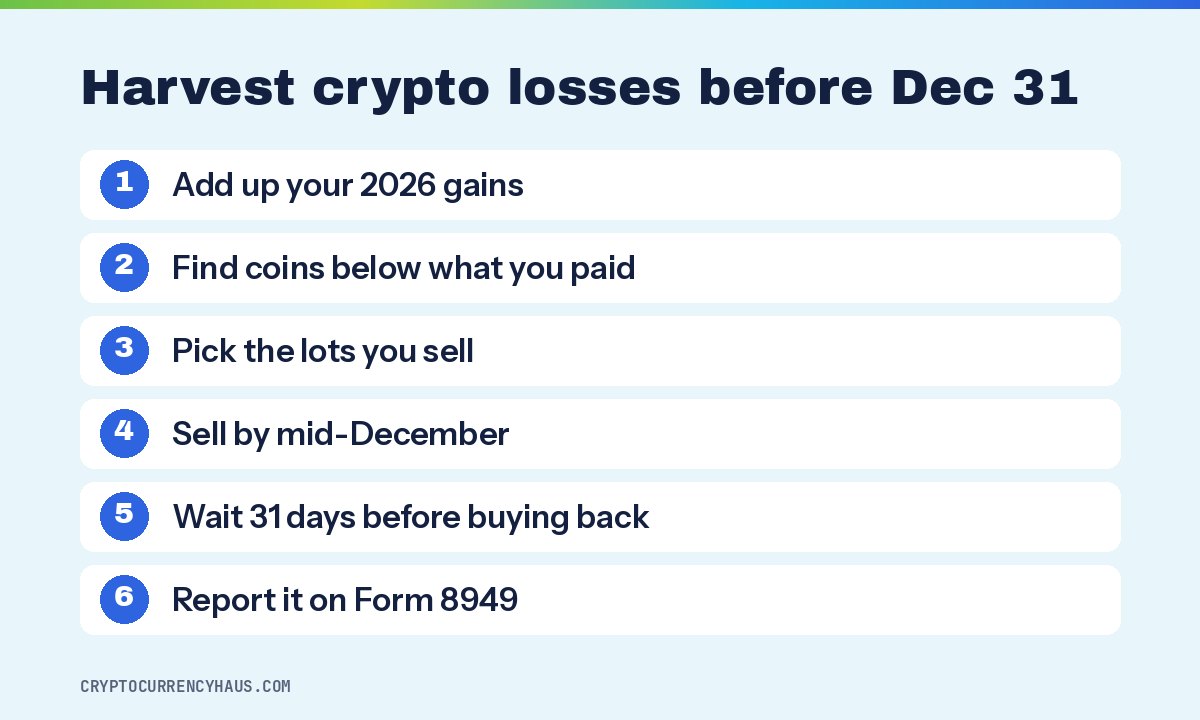
How to harvest crypto losses before December 31, step by step
- Add up your 2026 gains so far. Check the realized gains and losses report in each exchange’s tax or statements section, plus any sales from a self-custody wallet. You need to know what you’re offsetting.
- Find coins below what you paid. Each exchange can show your cost basis per asset, but only for coins it knows you bought there. If you’ve moved crypto between platforms, a tax app that imports everything gives the real picture.
- Check which lots you’d be selling. If you bought the same coin at different prices, the lot you sell decides the size of the loss. Since 2025, basis is tracked separately for each wallet and account. At an exchange, the IRS says you choose specific units by telling the broker no later than the time of the sale, using the identifiers it accepts. Otherwise its default method applies, often first in, first out (FIFO). In a self-custody wallet, the IRS default is FIFO within that wallet. Check your exchange’s cost basis setting before you sell.
- Look at the holding period. A coin you’ve held just under a year produces a short-term loss, which offsets short-term gains taxed at your full income rate. That’s usually the most valuable kind.
- Decide what happens after the sale using the table above. Write the date 31 days out on your calendar if you plan to buy back.
- Sell early, not at 11:59 p.m. on December 31. The trade date decides the tax year, not when the cash settles. Some exchanges timestamp trades in UTC, which ticks over to January 1 at 7 p.m. Eastern on December 31, and apps can lag during busy periods. Aim for mid-December.
- Save the records. Download the trade confirmation and your purchase history now. You’ll need them for Form 8949.
Trading fees and the buy-sell spread come out of what you save, so a $40 loss on a coin with a wide spread usually isn’t worth harvesting. Our best crypto tax software comparison shows which tools pull in every exchange and wallet, which is the hard part of step 2.
When is tax-loss harvesting not worth it?
- Your gains are already taxed at 0%. Long-term gains are taxed at 0% while your taxable income stays under the limits in the table below (full brackets are in our crypto tax guide). Using a loss to erase a 0% gain saves nothing. The loss is better saved for a year when it helps.
- You’ll buy back and sell again soon at a higher price. Harvesting and rebuying lowers your cost basis in the new coins, so part of the tax is pushed into the future rather than erased. The rebuy also restarts your holding period. It still pays when the loss offsets short-term gains taxed at your full rate.
- The loss is small. Fees and spreads can eat a small loss entirely.
- You’d sell something you can’t easily buy back. Some exchanges limit which coins you can buy in certain states, and a delisted coin may be hard to get again.
- You’d be selling to a spouse or your own business. Losses on sales to related parties are generally disallowed (section 267), so a “sale” to your spouse doesn’t create a deductible loss.
| 2026 filing status | 0% rate up to | 15% rate up to |
|---|---|---|
| Single | $49,450 | $545,500 |
| Married filing jointly | $98,900 | $613,700 |
| Head of household | $66,200 | $579,600 |
| Married filing separately | $49,450 | $306,850 |
If you’re under the 0% line, the useful year-end move may be the opposite one: selling a winner to lock in a long-term gain at 0% and buying back at a higher basis. That gain still raises your income for things like credits and state tax, so run it past a tax professional first.
How do you report harvested crypto losses?
Each sale goes on Form 8949 with its dates, proceeds and cost basis, and the totals go to Schedule D of your Form 1040. Schedule D is where the $3,000 limit and the carryforward are worked out. Save that year’s return, because next year’s carryover worksheet starts from it. Leftover losses keep their type: a short-term loss carries forward as short-term, a long-term one as long-term.
Your exchange will send a Form 1099-DA for 2026 sales by February 16, 2027 (the usual February 15 deadline falls on Presidents’ Day). Check the cost basis on it before you rely on it. For coins bought before 2026 or transferred in from another wallet, basis is often blank, and a blank or $0 basis would make your harvested loss look like a gain. You fix that on Form 8949 with your own records.
What mistakes do beginners make with crypto losses?
- Thinking a price drop counts. No sale, no loss on your return.
- Forgetting swaps are sales. Trading a losing coin for a stablecoin realizes the loss. Trading a winning coin for another coin realizes a gain you have to report.
- Believing the $3,000 cap limits everything. It only limits losses against ordinary income. Losses against gains are unlimited.
- Selling the wrong lot. The default method on your exchange may sell coins with a smaller loss than the ones you meant to sell.
- Waiting until the last day. A sale made on January 1 counts for 2027.
- Swapping into the wrapped version. Under the pending bill, wrapped BTC or ETH would count as the same asset, so it isn’t a workaround.
- Treating stolen or scammed coins like a normal sale. Coins lost to a scam fall under theft loss rules, not the capital loss rules on this page. A 2025 IRS Chief Counsel memo says some scam victims can deduct the loss when they handed over money expecting an investment profit, but it turns on the facts. Ask a tax professional, and see our guide to crypto scams to avoid the next one.
The bottom line
If you had crypto gains in 2026 and also hold coins that are well below what you paid, harvesting before December 31 is one of the few legal ways to cut this year’s tax bill. Sell in mid-December, keep the records, and wait 31 days before buying the same coin back while Congress decides on the wash sale bill.
If you had no gains and a modest income, a loss still helps, up to $3,000 a year. If your gains already fall in the 0% bracket, skip it. Got coins spread across several exchanges and wallets? Use tax software or a CPA to find your real cost basis first. Each exchange app only tells part of the story.
Koinly: run the numbers on a sale first
- Shows unrealized gains and losses across every account
- Tracks cost basis wallet by wallet
- Builds your Form 8949 at tax time
Free to import and preview. You pay only to download tax reports. Affiliate link. Read our Koinly review
Frequently asked questions
Can you write off crypto losses?
Yes, once you sell, trade or spend the crypto. Realized losses offset capital gains with no limit, then up to $3,000 a year of other income ($1,500 if married filing separately), and any extra carries forward to future years.
Can I sell crypto at a loss and buy it back the same day?
Under current law the wash sale rule doesn’t cover crypto, so it isn’t banned. But H.R. 10357, approved by the House Ways and Means Committee in September 2026, would extend the rule to crypto sold after September 14, 2026 if it passes as written. Waiting 31 days avoids the question.
Is there a 24-hour or 72-hour rule for buying back crypto?
No. Some guides mention one, but US tax law has no such rule. Today there’s no waiting period for crypto at all. Under the pending bill, the window would be 30 days before and 30 days after the sale.
What is the deadline for crypto tax-loss harvesting in 2026?
The sale has to happen by December 31, 2026 to count on your 2026 return. Don’t leave it to the final hours, because the sale date your exchange records is what counts.
What happens if my crypto losses are more than $3,000?
The $3,000 limit only applies after your losses have offset all your capital gains. Whatever remains above $3,000 carries forward to next year and keeps carrying forward until it’s used.
Is crypto tax-loss harvesting legal?
Yes. Selling an investment at a loss and reporting it is legal and common with stocks too. The risks are selling to a related party, rebuying in a way that lacks economic substance, and a possible new wash sale rule for crypto.
Do I need to sell for cash, or can I swap to another coin?
A swap counts as a sale, so trading a losing coin for a stablecoin or another coin realizes the loss. Just remember the coin you receive starts a new holding period.
How we researched this guide
We checked the loss rules against IRS Topic 409 and the Schedule D instructions, the wash sale and related statutes in the US Code, IRS Rev. Proc. 2025-32 and the IRS digital asset FAQs, and read the text of H.R. 10357 and the Joint Committee on Taxation’s description of it on October 28, 2026. We then read the top-ranking guides and checked their claims against those sources. Tax software appears because it solves the cost basis problem, and partners can’t pay for our rankings. Read our review process.
Sources
- IRS: Topic 409, Capital gains and losses (checked October 28, 2026)
- IRS: Instructions for Schedule D (Form 1040) (checked October 28, 2026)
- IRS: Notice 2014-21, virtual currency treated as property (checked October 28, 2026)
- IRS: Rev. Proc. 2025-32, 2026 inflation adjustments (checked October 28, 2026)
- IRS: Rev. Proc. 2024-28, wallet-by-wallet basis (checked October 28, 2026)
- IRS: Publication 550, trade date and holding period (checked October 28, 2026)
- IRS: Frequently asked questions on digital asset transactions (FAQs 82 to 86, identifying units) (checked October 28, 2026)
- IRS: Chief Counsel Memorandum 202511015, theft losses for scam victims (checked October 28, 2026)
- 26 U.S.C. 1091, loss from wash sales of stock or securities (checked October 28, 2026)
- 26 U.S.C. 7701(o), economic substance doctrine (checked October 28, 2026)
- 26 U.S.C. 267, losses between related parties (checked October 28, 2026)
- Congress.gov: H.R. 10357, Digital Asset Tax Certainty Act, actions (checked October 28, 2026)
- H.R. 10357 bill text as introduced, section 301 (wash sales) (checked October 28, 2026)
- Joint Committee on Taxation: Description of H.R. 10357 (checked October 28, 2026)
- House Ways and Means Committee: markup release, September 16, 2026 (checked October 28, 2026)