Christy Lynn
You sold some bitcoin, swapped a coin or two, maybe earned a little staking income, and now the tax software is asking questions you can’t answer. This page walks through how to report crypto on taxes for your 2026 return, form by form and box by box. It’s one part of our crypto tax guide for US investors.
Quick answer: To report crypto on taxes, list every sale, swap and purchase made with crypto on Form 8949, using the new digital asset boxes G to L. Carry the totals to Schedule D, and the net gain or loss to Form 1040, line 7a. Staking and other crypto income goes on Schedule 1, line 8v (or Schedule C for a business). Then answer the digital asset question on page 1 of Form 1040. Returns for 2026 are due April 15, 2027.

Koinly: builds your Form 8949 for you
- Imports exchanges and wallets, then matches transfers between them
- Tracks cost basis wallet by wallet, as the IRS now requires
- Exports Form 8949, Schedule D totals and a TurboTax file
Free to import and preview your gains. You pay to download reports. Affiliate link.
Forms and line numbers were checked on November 4, 2026 against the 2025 IRS forms and instructions and the 2026 draft forms the IRS has posted. Final 2026 forms can still change. This is education, not tax advice. If your situation is complicated, talk to a CPA or enrolled agent.
What crypto do you have to report?
The IRS treats crypto as property, not currency. So every time you get rid of a coin, you have a gain or a loss to report, the same as if you’d sold a stock. That includes more than selling for dollars.
- Report it: selling crypto for dollars, swapping one coin for another (including into a stablecoin), spending crypto on goods or services, and receiving crypto as staking rewards, mining income, airdrops or pay.
- Nothing to report as a sale: buying crypto with dollars and holding it, and moving crypto between wallets or accounts you own.
There’s no minimum. A $40 sale counts the same way a $40,000 sale does, whether or not an exchange sends you a form. If you lost money, you still report it, and the loss can lower your tax bill. Our guide to crypto tax-loss harvesting explains how losses offset gains.
Which tax forms do you need for crypto?
Most people need three forms: Form 8949, Schedule D and Form 1040. Add Schedule 1 if you earned crypto, or Schedule C and Schedule SE if you earned it as a business. Here’s where each kind of activity ends up.
| What happened | Where you report it | Form you may receive |
|---|---|---|
| Sold, swapped or spent crypto | Form 8949, then Schedule D, then Form 1040 line 7a | Form 1099-DA from the exchange |
| Staking, airdrop or hobby mining income | Schedule 1, line 8v | Form 1099-MISC if $2,000 or more in 2026 |
| Mining or validating as a business | Schedule C, plus Schedule SE | Form 1099-MISC or 1099-NEC |
| Paid in crypto as an employee | Form 1040, line 1a (wages) | Form W-2 |
| Paid in crypto as a freelancer | Schedule C, plus Schedule SE | Form 1099-NEC if $2,000 or more in 2026 |
| Only bought and held | Answer “No” to the 1040 question (if nothing else happened) | None |
One change trips people up this year. Exchanges used to send a Form 1099-MISC once your rewards hit $600. For payments made in 2026, the IRS threshold for 1099-MISC and 1099-NEC is $2,000. Several guides and some exchange help pages still say $600. Either way, the form only decides whether you get paperwork. You owe tax on rewards of any size.
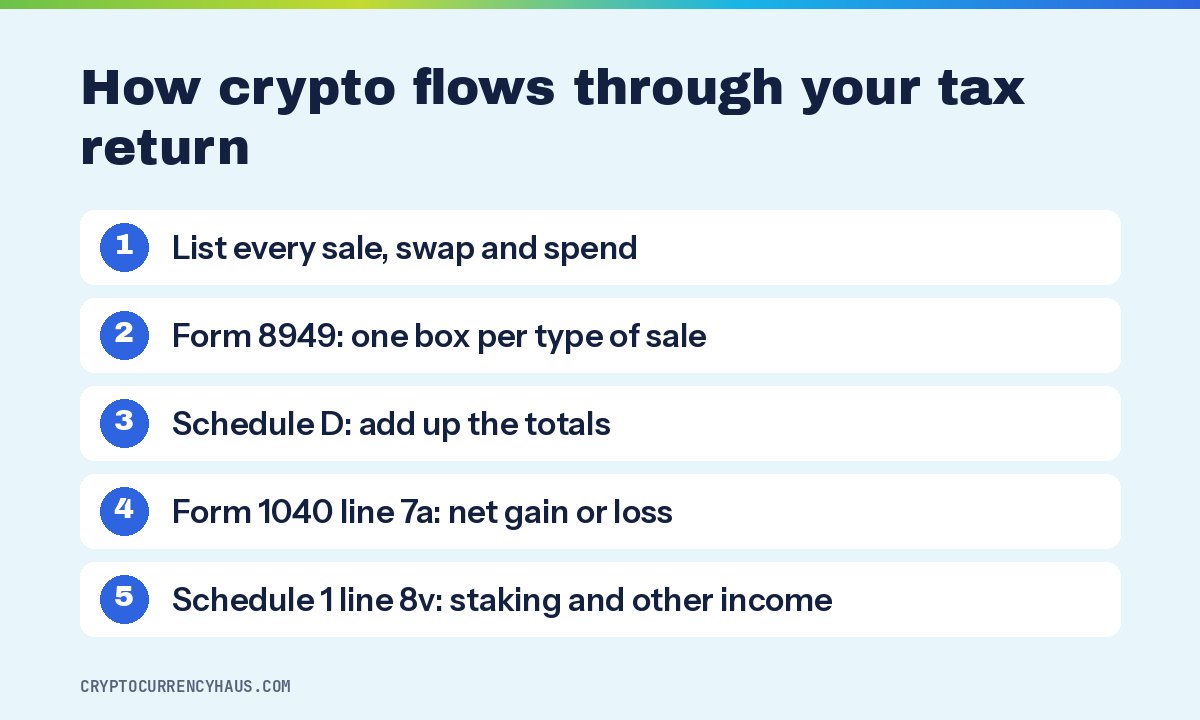
How to report crypto on taxes, step by step
1. Gather every record
Download the full 2026 transaction history from every exchange and app you used, plus any Form 1099-DA or 1099-MISC they send. Exchanges have until February 16, 2027 to furnish the 2026 Form 1099-DA, so don’t file the day you get your W-2. For self-custody wallets such as MetaMask or a Ledger, export the history from the wallet app or a block explorer.
Missing an old account? Log in and pull it anyway. A coin you bought there in 2021 and sold somewhere else in 2026 needs that original purchase price.
2. Work out the gain or loss on each disposal
For each sale, swap or purchase made with crypto you need four numbers: the date you got the coin, the date you gave it up, what you received (proceeds) and what you paid (cost basis, including fees). Proceeds minus basis is your gain or loss.
The dates decide the tax rate. Held one year or less, it’s a short-term gain, taxed like your paycheck. Held more than a year, it’s long-term and gets the lower 0%, 15% or 20% rates. The 2026 crypto tax rates are in the hub guide.
Since 2025, basis is tracked wallet by wallet. A coin’s purchase price stays with the wallet or account that holds it, so you can’t pick the cheapest coin from a different account to match a sale.
3. Sort each disposal into a Form 8949 box
Form 8949 has a separate box for each type of transaction, and starting with 2025 returns the IRS added six boxes just for digital assets. Most guides still only list the old stock boxes A to F. For crypto, the IRS instructions say to use G to L, and they say outright not to use box F for digital assets. The full box table is further down.
4. Fill in Form 8949
Each row is one disposal. Short-term sales go in Part I, long-term in Part II. Use a separate page for each box you check.
- Column (a), description: the coin’s name or symbol and the exact units, such as “0.1 BTC”. The IRS asks for the transaction ID too, if you have it.
- Columns (b) and (c): date acquired and date sold or disposed of.
- Column (d), proceeds: what you received in dollars. For a swap, it’s the dollar value of the coin you received.
- Column (e), cost basis: what you paid, plus fees.
- Columns (f) and (g): a code and an adjustment, only when something needs correcting. Code B, for example, means the basis on your 1099-DA is wrong.
- Column (h): gain or loss, which is (d) minus (e), plus or minus any adjustment.
5. Carry the totals to Schedule D
Each Form 8949 page has a totals line. Those totals go on Schedule D: short-term on lines 1b, 2 or 3, long-term on lines 8b, 9 or 10, depending on the box. Schedule D nets them. Line 7 is your net short-term result, line 15 your net long-term result, and line 16 the combined figure that goes to Form 1040, line 7a.
If line 16 is a loss, you can deduct up to $3,000 of it against other income ($1,500 if married filing separately) and carry the rest to next year.
6. Report crypto income separately
Staking rewards, airdrops and hobby mining aren’t capital gains. Add up the dollar value of each reward on the day you could use it. The total goes on Schedule 1, line 8v: “Digital assets received as ordinary income not reported elsewhere.” That amount also becomes your cost basis in those coins when you sell them later. More on this below.
7. Answer the digital asset question and file
Check “Yes” or “No” on page 1 of Form 1040 (the wording is in the question section). Keep your exports, the 8949 and every 1099 for at least three years. Then file by April 15, 2027, or request an extension to file (an extension doesn’t extend the time to pay).
Which Form 8949 box do you check for crypto?
Pick the box from two facts: did you get a Form 1099-DA for the sale, and does it say basis was reported to the IRS? Your 1099-DA has a checkbox for that. The Form 1099-DA explained guide walks through every box on the form itself.
| Your situation | Short-term (1 year or less) | Long-term (over 1 year) |
|---|---|---|
| 1099-DA shows basis was reported to the IRS | Box G, to Schedule D line 1b | Box J, to Schedule D line 8b |
| 1099-DA, but basis wasn’t reported | Box H, to Schedule D line 2 | Box K, to Schedule D line 9 |
| No 1099-DA (self-custody wallet, DeFi, foreign exchange) | Box I, to Schedule D line 3 | Box L, to Schedule D line 10 |
Expect most 2026 crypto sales to land in H, I, K or L. Exchanges only report basis on coins bought in that same account on or after January 1, 2026. Anything older, or anything you moved in from another wallet, usually shows proceeds with no basis, so you supply it.
Worked example: one beginner’s 2026 crypto return
Here’s a made-up but typical year. Maya is single and had four crypto events in 2026.
- Bought 0.1 BTC on an exchange in February 2026 for $8,000 and sold it there in March for $9,000. Her 1099-DA shows basis reported to the IRS.
- Bought 2 ETH in 2023 for $3,000, moved them to a second exchange and sold them in June 2026 for $6,000. That exchange’s 1099-DA shows $6,000 of proceeds and no basis.
- Swapped 10 SOL (bought in January 2026 for $2,000) for ETH worth $1,500 inside her own wallet in September. No form.
- Earned $300 of staking rewards on the first exchange over the year. No 1099-MISC, because that’s under $2,000.
| Event | Where it goes | Result |
|---|---|---|
| 1. BTC sale | Form 8949 box G (or straight to Schedule D line 1a) | $1,000 short-term gain |
| 2. ETH sale | Form 8949 box K, basis $3,000 entered by Maya | $3,000 long-term gain |
| 3. SOL swap | Form 8949 box I | $500 short-term loss |
| 4. Staking rewards | Schedule 1, line 8v | $300 ordinary income |
On Schedule D, her short-term lines net to $500 ($1,000 gain minus the $500 loss) on line 7. Her long-term line shows $3,000 on line 15. Line 16 is $3,500, and that goes on Form 1040, line 7a. The $300 of staking income flows from Schedule 1 to Form 1040, line 8. She answers “Yes” to the digital asset question.
Notice what would have happened if she’d typed the second 1099-DA in as-is with no basis: a $6,000 gain instead of $3,000. Proceeds aren’t profit. Adding the basis the exchange didn’t know about is the single biggest money-saver on most crypto returns.
Can you skip Form 8949?
Sometimes. The Schedule D instructions let you put totals straight on line 1a (short-term) or 8a (long-term) when your 1099-DA shows basis was reported to the IRS and you have nothing to adjust. In the IRS’s own example, a sale with $6,000 of proceeds and $2,000 of basis goes directly on line 8a with a $4,000 gain, no Form 8949 needed.
For crypto in 2026, few people qualify for all their sales, because most coins were bought before 2026 or moved between accounts. Use the shortcut for the sales that fit, and Form 8949 for the rest.
Got hundreds of trades? You don’t have to type each one onto the form. The Form 8949 instructions allow an attached statement with the same columns. You enter one summary row per box that says “see attached statement,” put code M in column (f), and attach the detail. Crypto tax software produces exactly that file.
How do you answer the crypto question on Form 1040?
The 2026 draft Form 1040 asks: “At any time during 2026, did you: (a) receive (as a reward, award, or payment for property or services); or (b) sell, exchange, or otherwise dispose of a digital asset (or a financial interest in a digital asset)?” Some popular guides still quote the old 2019 “virtual currency” wording. It changed years ago.
- Check “Yes” if you sold, swapped or spent crypto, or received it as staking rewards, mining income, an airdrop, a hard fork, a reward or pay.
- “No” is fine if all you did was hold crypto, move it between wallets or accounts you own, or buy it with dollars.
The IRS says you must answer whether or not you got a Form 1099-DA, and you can’t leave it blank. Answering “Yes” doesn’t create tax by itself. It just tells the IRS to expect crypto on the rest of the return.
Where do staking rewards and other crypto income go?
For most people, staking rewards, airdrops and small-scale mining go on Schedule 1, line 8v. The IRS instructions name forks, staking and mining as examples for that line. Our guide to whether staking rewards are taxed covers timing and values in detail. Some older guides send it to line 8z (“other income”). Line 8v is the dedicated line now.
- Running a business (a real validator or mining operation run for profit): Schedule C instead, where you can deduct expenses. You also owe self-employment tax on Schedule SE once net earnings reach $400.
- Paid in crypto by an employer: it’s wages, already on your W-2.
- Received crypto as a gift: not income, and it doesn’t go on line 8v. You generally take over the giver’s cost basis for when you sell.
The value you report as income becomes your cost basis. If you report $300 of rewards and later sell them for $450, only the $150 difference is a capital gain. You aren’t taxed twice on the same dollars.
What if you didn’t get a 1099-DA?
You still report every sale. Self-custody wallets, decentralized exchanges and many foreign platforms don’t send 1099-DAs. Those sales go on Form 8949 with box I (short-term) or box L (long-term), using your own records.
If you used a US exchange and expected a form but didn’t get one by mid-February 2027, check the tax documents section of your account first. Then contact support. Don’t wait on it past the filing deadline: you can file from your own transaction history.
Mistakes that cost beginners money
- Treating 1099-DA proceeds as profit. A blank or $0 basis means the exchange didn’t know your cost, not that you had none.
- Counting transfers as sales. Moving coins from an exchange to your own wallet isn’t a disposal. Software sometimes tags it as one until you match the two sides.
- Forgetting swaps. Trading ETH for a stablecoin, or one token for another in a wallet app, is a taxable disposal even though no dollars hit your bank.
- Using the old boxes. Crypto belongs in boxes G to L. Box F is specifically ruled out for digital assets.
- Skipping small rewards. $40 of staking income with no 1099 is still income.
- Leaving out losses. A loss you don’t report is a deduction you never get.
Do you need crypto tax software or a tax pro?
If you made two or three sales on one exchange, you can fill in Form 8949 by hand from your 1099-DA and a purchase receipt. Most tax apps have a crypto section that asks for the same columns.
Past that, software saves hours and catches mistakes. It pulls every account together, matches transfers, rebuilds basis wallet by wallet and outputs the 8949 file. Koinly and CoinTracker both let you import and preview before you pay. Our best crypto tax software comparison covers prices and which one fits which kind of investor.
Call a CPA or enrolled agent if you ran a validator or mining operation, used DeFi lending or liquidity pools heavily, got scammed, or never reported crypto in earlier years. Those cases have judgment calls software can’t make for you.
The bottom line
- A few sales on one exchange: fill in Form 8949 by hand in boxes G to L, or use the Schedule D line 1a/8a shortcut where your 1099-DA shows basis.
- Several exchanges, wallets or swaps: use crypto tax software. Koinly is our pick for most beginners because it handles transfers between accounts well and exports a ready-made 8949.
- Staking or business income, or past years unreported: software for the records, then a tax professional for the judgment calls.
Whatever route you take, the order is the same: gather, calculate, sort into boxes, total on Schedule D, add income on Schedule 1, answer the question, file.

CoinTracker: built around exchange accounts
- Connects Coinbase and other major exchanges
- Produces Form 8949 and Schedule D reports
- Exports to TurboTax
Pricing depends on how many transactions you have. Affiliate link.
Frequently asked questions
Do I have to report crypto if I didn’t sell?
If you only bought crypto with dollars and held it, or moved it between your own wallets, there’s no sale to report and you can answer “No” to the 1040 question. If you swapped, spent or earned crypto, you do have something to report, even without selling for cash.
Do I have to report crypto under $600?
Yes. There’s no minimum for reporting crypto gains or income. The $600 figure (now $2,000 for payments made in 2026) only decides whether an exchange sends you a Form 1099-MISC. It doesn’t change what you owe.
Where does crypto go on Form 1040?
Your net capital gain or loss from Schedule D goes on Form 1040, line 7a. Crypto income from Schedule 1, line 8v, flows into Form 1040, line 8. The yes-or-no digital asset question is on page 1.
Which Form 8949 box do I use for crypto?
Use the digital asset boxes: G, H or I for short-term sales and J, K or L for long-term sales, depending on whether you got a Form 1099-DA and whether it shows basis reported to the IRS. Don’t use box F for crypto.
What if I have hundreds of crypto trades?
You can attach a statement with all the trades instead of typing each one on Form 8949. Enter one summary row per box with “see attached statement” and code M. Crypto tax software creates this statement for you.
What happens if I don’t report crypto?
Exchanges now send the IRS a Form 1099-DA for your sales, so unreported sales are easy to spot. You could owe the tax plus interest and penalties. If you missed crypto in past years, a tax professional can help you amend before the IRS writes to you.
How we researched this guide
On November 4, 2026 we read the IRS’s 2025 Form 1040, Schedule 1, Schedule D and Form 8949 instructions, the 2026 draft forms, and the 2026 instructions for Forms 1099-MISC and 1099-NEC. Then we read the top-ranking guides for this question and checked their claims against those documents. Most still describe the old Form 8949 boxes, and two quote a retired version of the 1040 crypto question. Tax software is listed because it solves the record-keeping problem, and partners can’t pay for our rankings. Read our review process.
Sources
- IRS: 2025 Instructions for Form 8949 (boxes G to L, no box F for digital assets, attached statements; checked November 2026)
- IRS: 2026 draft Form 8949 (checked November 2026)
- IRS: 2025 Instructions for Schedule D (lines 1a and 8a, codes G to L; checked November 2026)
- IRS: 2026 draft Form 1040 (digital asset question, line 7a; checked November 2026)
- IRS: 2025 Form 1040 instructions (when to answer Yes or No; Schedule 1 line 8v; checked November 2026)
- IRS: 2026 draft Schedule 1 (line 8v; checked November 2026)
- IRS: Instructions for Forms 1099-MISC and 1099-NEC (Rev. December 2026) ($2,000 threshold; checked November 2026)
- IRS: Instructions for Schedule SE ($400 threshold; checked November 2026)
- IRS Topic 409: Capital gains and losses ($3,000 loss limit; checked October 2026)
- IRS Publication 1099 (1099-DA furnish date Feb 16, 2027; checked October 2026)