Christy Lynn
Your exchange shows a small pile of staking rewards, a few cents or a few dollars at a time, and nobody has asked you for tax yet. Are staking rewards taxed, and when? Here’s the IRS rule, what it costs in real numbers, and how to report it on your 2026 return. It’s part of our crypto tax guide for US investors.
Quick answer: Yes. In the US, staking rewards are taxed as ordinary income at their dollar value on the day you can sell or move them, even if you never sell (IRS Revenue Ruling 2023-14). You report them on Schedule 1, line 8v. When you later sell the rewards, you owe capital gains tax only on the change in value since then. Exchanges send a Form 1099-MISC only if your 2026 rewards reach $2,000, but every dollar is taxable.

Koinly: values every reward on the day you got it
- Imports staking history from exchanges and wallets
- Prices each reward at receipt and totals your income
- Carries that value forward as cost basis for later sales
Free to import and preview. You pay to download tax reports. Affiliate link.
IRS rules on this page were checked on November 4, 2026 against Revenue Ruling 2023-14, the 2025 and draft 2026 tax forms and the 2026 Form 1099-MISC instructions. This is education, not tax advice. If you run a validator or stake through DeFi, talk to a CPA or enrolled agent.
Are staking rewards taxed when you receive them?
Yes. The IRS settled this in July 2023 with Revenue Ruling 2023-14. It says the fair market value of staking rewards counts as gross income in the year you gain “dominion and control” over them. In plain English: the moment you’re able to sell, swap or send the coins, they’re income, valued in dollars at that date and time.
The ruling covers staking on your own and staking through an exchange. It doesn’t matter whether you leave the rewards sitting in your account, restake them automatically or never convert them to dollars. Not selling doesn’t delay the tax.
Rewards you truly can’t touch yet are different. In the ruling’s own example, rewards locked by the network until the next day become income on that next day, when the lock ends. So the clock starts when you can use them, not when they’re created.
Are staking rewards taxed twice?
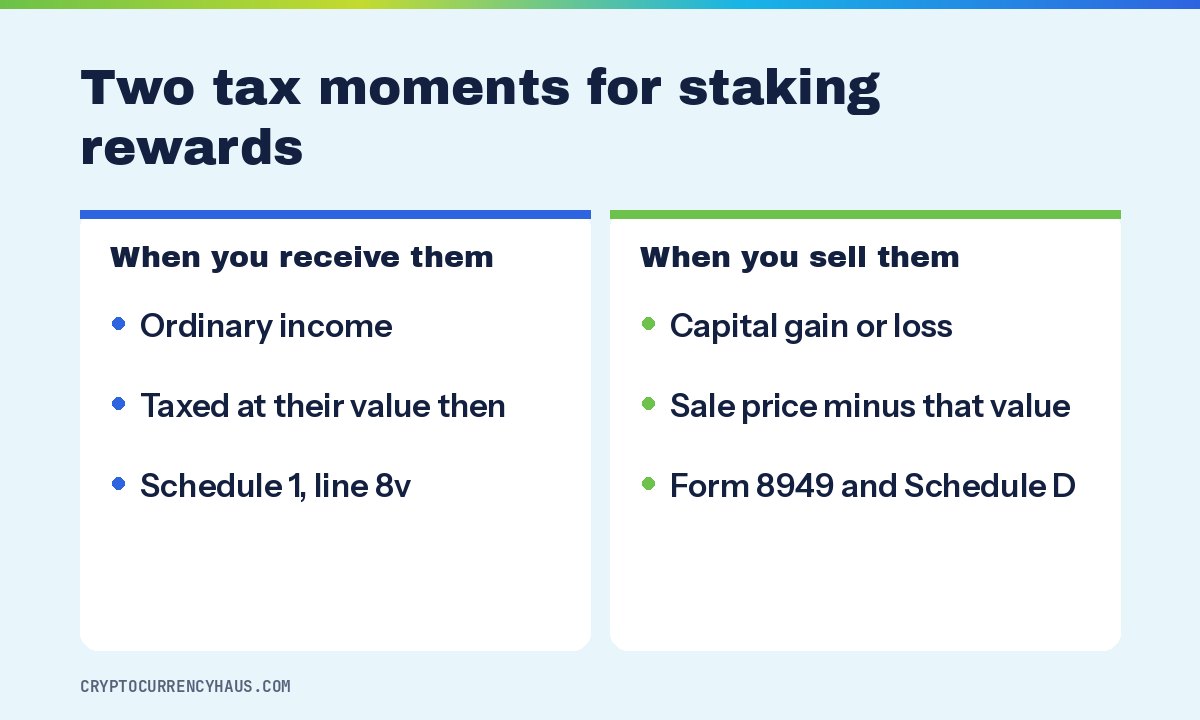
No, though it can feel that way. There are two tax moments, and each one taxes a different slice of value.
- When you receive a reward: its dollar value that day is ordinary income, taxed at your normal income tax rate. That value becomes your cost basis in the coin.
- When you sell, swap or spend it: you have a capital gain or loss equal to the sale price minus that cost basis. Hold the reward more than a year and any gain gets the lower long-term rates.
Each reward starts its own one-year clock on the day you received it. A reward from January 2026 can be long-term by February 2027, while one from December 2026 is still short-term. Software tracks this; a spreadsheet gets painful fast.
There’s a real risk hiding here. You owe income tax on the value at receipt, even if the price falls before you sell. Crypto prices can drop sharply, so set aside cash for the tax rather than counting on the coins to cover it.
How much tax will you pay on staking rewards? A worked example
Here’s a made-up but realistic case. Jordan is single, earns a salary that puts them in the 22% federal bracket for 2026 (taxable income between $50,400 and $105,700), and stakes ETH on a US exchange.
| Step | What happens | Tax effect |
|---|---|---|
| Rewards in 2026 | 0.40 ETH arrives in weekly drops. Added up at each day’s price, it was worth $1,200 when received. | $1,200 of ordinary income on Schedule 1, line 8v. About $264 of federal tax at 22%, plus any state tax. |
| Tax forms | $1,200 is under the $2,000 threshold, so no Form 1099-MISC arrives. | Still reportable. The form only decides whether the IRS gets a copy. |
| Sale in 2027 | Jordan sells all 0.40 ETH for $1,000 after prices fall. | $200 capital loss ($1,000 minus $1,200 basis), split short-term and long-term by each reward’s date. |
Two lessons. First, the income tax is due for 2026 even though Jordan sold for less. Second, the later loss isn’t wasted: it offsets other capital gains, and up to $3,000 of other income a year. Our page on crypto tax-loss harvesting explains how to time that.
Does it matter how you stake?
The core rule is the same everywhere: rewards are income when you control them. What changes is the paperwork, and how settled the rules are.
- On an exchange (Coinbase, Kraken, Gemini): you get a downloadable rewards history, plus Form 1099-MISC if your 2026 rewards reach $2,000. Each daily or weekly credit is a separate income event.
- From your own wallet or a validator: no form at all. You record the date, amount and dollar value of every reward yourself.
- Liquid staking (stETH, rETH, cbETH): usually no form. The IRS hasn’t said whether swapping ETH for a liquid staking token is a taxable trade, so get professional advice before large swaps.
- Staking as a business: possibly a 1099-MISC or 1099-NEC. Income goes on Schedule C, with self-employment tax once net earnings reach $400.
Sources for this list: IRS Rev. Rul. 2023-14, Notice 2024-57, and the Form 1099-MISC/NEC and Schedule SE instructions, checked November 2026.
One thing that confuses people: Form 1099-DA doesn’t report your staking rewards. IRS Notice 2024-57 lets brokers skip 1099-DA reporting for staking transactions until further guidance, and the IRS says rewards fall outside that exception, which is why they come on a 1099-MISC instead. Your 1099-DA only shows it later, when you sell the rewarded coins. If you want the full background, see Form 1099-DA explained.
How do you report staking rewards on your taxes?
- Download your 2026 staking rewards history from every exchange and wallet. Exchanges usually list each reward with a date and a dollar value.
- Add up the dollar value of every reward at the time you could use it. That total is your staking income.
- Enter the total on Schedule 1, line 8v, “Digital assets received as ordinary income not reported elsewhere.” Some guides say line 8z; 8v is the dedicated line on the 2025 form and the 2026 draft.
- If staking is a real business for you, use Schedule C instead and file Schedule SE for self-employment tax.
- Answer “Yes” to the digital asset question on Form 1040. The IRS lists “mining, staking and similar activities” as a reason to check Yes.
- Keep the reward records. When you sell those coins, you’ll need each reward’s date and value as its cost basis on Form 8949.
For the forms side (which Form 8949 box to check when you sell, how Schedule D works), see our step-by-step guide on how to report crypto on taxes.
Can you deduct staking costs?
Usually not, for a regular investor. If staking is a hobby or a side investment, hardware, electricity and service fees aren’t deductible for 2026. The 2025 tax law made the old suspension of those deductions permanent, so some older guides that say you can deduct expenses up to your income are out of date.
If you run validators as a genuine business, with a profit motive, regular activity and proper records, Schedule C lets you deduct ordinary business costs. Business status also brings self-employment tax. That trade-off is worth a conversation with a tax professional.
Could the staking tax rules change?
Not soon, from what’s on the table. Two things get mentioned a lot:
- The Jarrett lawsuits. A Tennessee couple argued that staking rewards shouldn’t be taxed until sold. The IRS refunded their tax in the first case, and the court called it moot. They filed a second suit in October 2024. We found no ruling in it as of November 2026, and the IRS position hasn’t changed.
- H.R. 10357, the Digital Asset Tax Certainty Act. The House Ways and Means Committee approved it 38 to 5 on September 16, 2026. As introduced, it would write into the tax code that staking and mining income is ordinary income, not delay it until sale. It hasn’t had a House floor vote.
Plan on the current rule for your 2026 return. We’ll update this page if Congress or the IRS changes it.
Watch for staking scams at tax time
Real staking pays modest, variable rewards set by the network. Be wary of any “staking” offer with a fixed high return, a lock-up you can’t exit, or a site that asks you to pay a “tax” or “fee” before withdrawing. The IRS also warns about a fake “Digital Assets Compliance Portal” letter on its digital assets page. Our crypto scams guide covers the common patterns, and is staking crypto safe? covers the legitimate risks.
The bottom line
- Staking on one exchange: download the rewards report, put the total on Schedule 1, line 8v, and keep the file for when you sell. You don’t need software for this alone.
- Several exchanges, wallets or frequent sales of rewards: use crypto tax software. Koinly is our pick for most beginners because it prices each reward at receipt and carries the basis forward automatically.
- Validators, liquid staking or DeFi: keep detailed records and get a tax professional. Some of the rules there aren’t settled.
Whichever applies, set aside part of each reward’s value for tax as you earn it. The bill arrives in April whether or not prices hold up.
Koinly: staking income and cost basis in one report
- Connects major exchanges and wallets
- Income report for Schedule 1 and Form 8949 for sales
- Exports to TurboTax and other tax apps
Free to import and preview. You pay to download tax reports. Affiliate link.
Frequently asked questions
Do I pay tax on staking rewards if I don’t sell them?
Yes. Under IRS Revenue Ruling 2023-14, rewards are income when you’re able to sell or move them, whether or not you do. Selling later is a separate event that creates a capital gain or loss.
Do I have to report staking rewards under $600?
Yes. There’s no minimum for staking income. The $600 figure (now $2,000 for rewards paid in 2026) only decides whether an exchange sends you a Form 1099-MISC.
Where do I report staking rewards on my tax return?
Most people report them on Schedule 1 (Form 1040), line 8v, as digital assets received as ordinary income. If staking is a business, they go on Schedule C instead.
Is liquid staking taxable?
The rewards are taxable income like any other staking rewards. Whether swapping ETH for a liquid staking token such as stETH is itself a taxable trade hasn’t been addressed by the IRS, so get professional advice before large swaps.
Are locked staking rewards taxable?
Not until you can use them. The IRS ruling’s example treats locked rewards as income on the day the lock ends and you can sell or transfer them.
What tax rate applies to staking rewards?
Your ordinary income tax rate, the same as wages, which for 2026 runs from 10% to 37% federally. When you later sell rewards you’ve held more than a year, any gain gets long-term capital gains rates.
How we researched this guide
On November 4, 2026 we read IRS Revenue Ruling 2023-14 in full, IRS Notice 2024-57 and the IRS digital assets page. We also read the 2025 and draft 2026 Form 1040 and Schedule 1, the 2026 Form 1099-MISC instructions and the text of H.R. 10357. Then we read the top-ranking staking tax guides and checked them against those sources. Several still cite the old $600 threshold or the wrong Schedule 1 line, and one says Form 1099-DA reports staking income. Partners can’t pay for our rankings. Read our review process.
Sources
- IRS Revenue Ruling 2023-14 (staking rewards are income at dominion and control; checked November 2026)
- IRS Notice 2024-57 (staking transactions and Form 1099-DA; checked November 2026)
- IRS: Digital assets (1040 question, Schedule 1, scam letter alert; checked November 2026)
- IRS: 2025 Form 1040 instructions (Schedule 1 line 8v; checked November 2026)
- IRS: 2026 draft Schedule 1 (checked November 2026)
- IRS: Instructions for Forms 1099-MISC and 1099-NEC (Rev. December 2026) ($2,000 threshold; checked November 2026)
- IRS Revenue Procedure 2025-32 (2026 tax brackets; checked November 2026)
- IRS: Instructions for Schedule SE ($400 threshold; checked November 2026)
- H.R. 10357 as introduced (section 401; checked November 2026)
- Sixth Circuit opinion in Jarrett v. United States (2023) (first case moot after refund)