Christy Lynn

You swapped a few tokens on Uniswap, parked some ETH in a liquidity pool, maybe claimed an airdrop. Nobody sent you a tax form, so does any of it count? This page explains DeFi taxes in plain English, using IRS sources only. For the bigger picture (rates, forms, deadlines) start with our crypto tax guide for US investors.
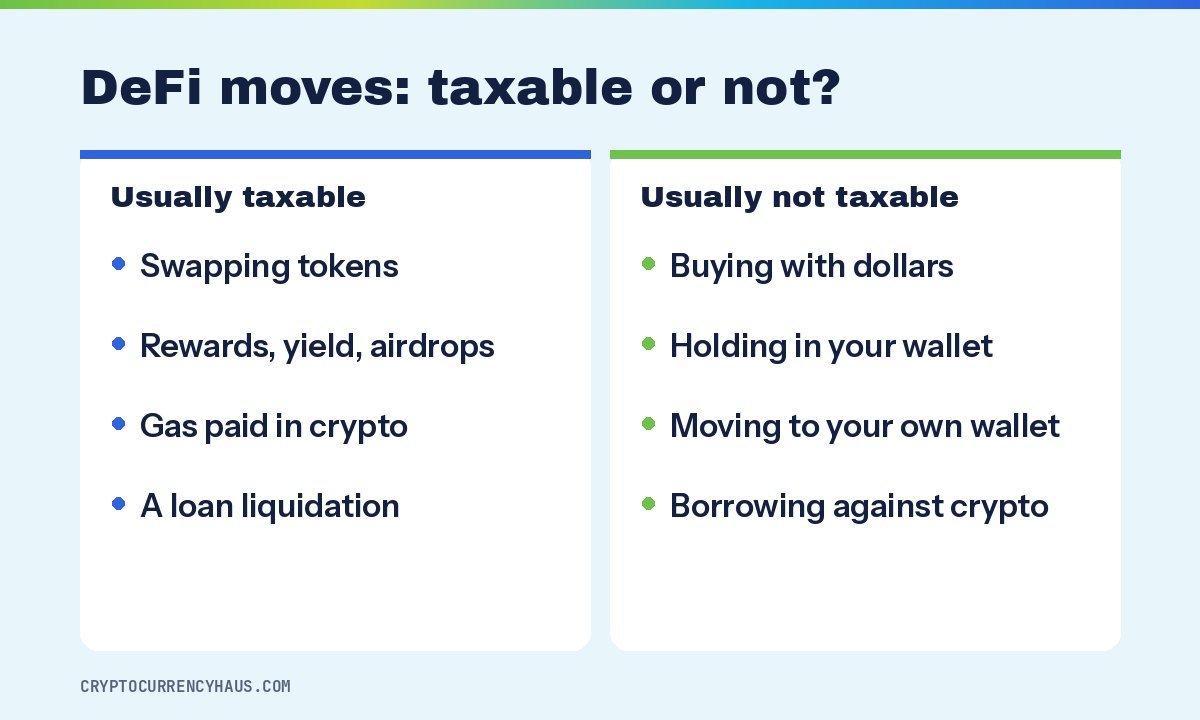
Quick answer: DeFi taxes follow the same IRS rules as any other crypto. Swapping one token for another is a taxable sale, and rewards, yield and airdrops are income when you can use them. Moving coins between your own wallets isn’t taxable. DeFi apps don’t send Form 1099-DA, because Congress repealed that rule on April 10, 2025, so you report everything from your own records.
Rules checked against IRS guidance in November 2026, for crypto you sell or earn in 2026 (taxes filed in 2027). The IRS hasn’t written DeFi-specific rules, so some answers below are “unsettled.” Talk to a tax professional about your own situation.
DeFi taxes at a glance
Here’s how each common DeFi move is usually treated, and how sure anyone can be about it.
| What you did | Usually taxed as | How settled |
|---|---|---|
| Swap tokens on a DEX | Capital gain or loss | Clear (IRS FAQ) |
| Staking, yield, interest | Ordinary income | Clear for staking |
| Airdrop you can use | Ordinary income | Clear for hard forks |
| Gas paid in crypto | Small disposal | Clear (IRS) |
| Move to your own wallet | Not taxable | Clear (IRS FAQ) |
| Borrow against crypto | Not taxable | Mostly clear |
| Loan liquidation | Capital gain or loss | Mostly clear |
| Add to a liquidity pool | Maybe a disposal | Unsettled |
| Wrap or bridge a token | Maybe a disposal | Unsettled |
Why are DeFi taxes different from exchange taxes?
DeFi (decentralized finance) means apps like Uniswap, Aave or Curve that run on smart contracts. You connect a self-custody wallet such as MetaMask, and there’s no company holding your coins. The tax rules are the same ones the IRS uses for all crypto. Digital assets are property: selling, swapping or spending them can create a capital gain or loss, and coins you earn are income.
The difference is paperwork. Coinbase, Kraken and other brokers now send Form 1099-DA for your sales. DeFi apps don’t. The IRS did write a rule in December 2024 that would have made DeFi front ends report, but Congress overturned it with a joint resolution signed on April 10, 2025 (Public Law 119-5). That rule now has “no force or effect.”
Missing paperwork doesn’t mean missing tax. Even for brokers, the IRS paused reporting on wrapping, liquidity pools, staking and lending in Notice 2024-57, and it said plainly that the pause creates no inference about whether those moves are taxable. Translation: the reporting gap is a paperwork decision, not a tax break. You still answer the digital asset question on Form 1040 and report every taxable event yourself.
Is moving crypto to MetaMask or a hardware wallet taxable?
It isn’t. The IRS says moving crypto between wallets or accounts you own is not a taxable event (IRS FAQ A38). That holds even if an exchange sends you a form about the withdrawal. Moving ETH from Coinbase to MetaMask, or from MetaMask to a Ledger, is just you moving your own property.
There’s one small catch. If you pay the network fee in crypto, that fee is a tiny disposal. The IRS digital assets page lists “paying a transfer fee with digital assets” as a transaction that requires a Yes on the Form 1040 question. On a $3 gas fee the gain or loss is usually pennies, but it still belongs in your records.
Keep your purchase history when you move coins. Since January 1, 2025, cost basis is tracked wallet by wallet (IRS Revenue Procedure 2024-28), and an exchange can’t see what you paid for coins that arrive from a private wallet. If you later send them back to sell, the exchange’s 1099-DA may show a blank cost basis, and you’ll fill it in from your own records.
Are DeFi swaps taxable?
Yes. A swap on a decentralized exchange is a sale of the token you give up. The IRS says exchanging one crypto for another creates a capital gain or loss (IRS FAQ A16). The gain is the value of what you received minus your basis in what you gave up (A17). It makes no difference that you never touched dollars.
An example: you bought 1 ETH for $2,000. Months later you swap it on Uniswap for 3,000 USDC. You have a $1,000 capital gain on the ETH, and your basis in the USDC is $3,000. Swaps into stablecoins count, even though the stablecoin itself barely moves in price.
How much tax that gain costs depends on how long you held the token. One year or less is short-term and taxed at your income tax rate. More than a year is long-term and taxed at 0%, 15% or 20%; for 2026 the 0% rate covers taxable income up to $49,450 for single filers (IRS Rev. Proc. 2025-32). Our 2026 crypto tax rates table has every bracket.
Active DeFi users can rack up hundreds of swaps a year. Each one is a separate line on Form 8949. That’s the main reason most people with real DeFi activity end up using crypto tax software rather than a spreadsheet.
How are DeFi rewards taxed: staking, yield and airdrops?
Tokens you earn are ordinary income at their dollar value when you gain “dominion and control,” meaning when you can sell, swap or move them. That’s the test in IRS Revenue Ruling 2023-14 for staking rewards, and most tax professionals apply the same logic to yield farming rewards, lending interest paid in tokens, and governance token rewards. The value you report as income becomes your cost basis for when you later sell.
- Staking rewards: income when you can withdraw or use them. We cover liquid staking and the details in whether staking rewards are taxed.
- Yield farming and lending interest: generally income at the value when the tokens are paid out or claimable.
- Airdrops: the IRS says coins from an airdrop after a hard fork are income when they land and you control them (IRS FAQ A23 and A24). Most pros treat other airdrops the same way.
For most hobby users, this income goes on Schedule 1. On the 2026 draft form it’s line 8v, “digital assets received as ordinary income not reported elsewhere.” If DeFi is your business, it goes on Schedule C instead. A few top-ranking guides still point to line 8z, which was the old catch-all line.
How are liquidity pools taxed?
This is the least settled part of DeFi taxes. When you add two tokens to a pool, you usually get an LP token (or, on Uniswap v3, an NFT) that represents your share. The IRS has never said whether handing over your tokens for that LP token is a sale. Tax pros and software vendors use one of two approaches:
- Treat the deposit as a swap (the conservative approach). You report a gain or loss on the tokens you put in, and your basis in the LP token is their value that day. When you withdraw, you report another gain or loss on the LP token.
- Treat the deposit as no sale (the deferral approach). Your basis carries over to the pool position, and you report nothing until you withdraw and get back tokens worth more or less than your basis.
Either way, fees and reward tokens paid to you as a liquidity provider are generally income. Impermanent loss (when pool rebalancing leaves you with less value than if you’d held) isn’t a deduction while you’re still in the pool. It only shows up as a lower gain or a capital loss when you withdraw.
Our take: pick one approach, write down why, and use it the same way every year. Switching back and forth to whatever gives the lowest tax that year is the kind of thing that looks bad in an audit. If your pool positions are large, this is the place to pay a crypto-savvy CPA.
Is borrowing against crypto taxable?
Generally, no. Loan money isn’t income, because you have to pay it back. If you lock ETH as collateral on Aave and borrow USDC, the borrowing itself usually isn’t taxed. The open question is the deposit: some protocols hand you a receipt token (such as an aToken) for your collateral, and a few pros treat that exchange like a swap. Most don’t.
A liquidation is different. If the price drops and the protocol sells your collateral to repay the loan, that’s a disposal of your crypto, even though you didn’t choose it. You report a capital gain or loss on the coins that were sold. Liquidations are also the fastest way to lose money in DeFi, so borrow well below the limit or don’t borrow at all.
Are wrapping and bridging taxable?
Unsettled. Wrapping ETH into WETH, or moving a token to another blockchain through a bridge, leaves you with roughly the same asset. Many pros treat a one-to-one wrap or bridge as not taxable, because your economic position doesn’t change. Others treat it as a swap, because you end up holding a different token issued by a different contract. The IRS named wrapping in Notice 2024-57 only to pause broker reporting, and said that implies nothing either way.
Same advice as pools: choose an approach, document it, stay consistent. Either way, the gas you pay to wrap or bridge is a small disposal if you pay it in crypto.
What about gas fees?
Gas fees work two ways at once. The ETH (or other coin) you spend on gas is a small disposal, with its own tiny gain or loss. And the fee itself usually counts as a cost of the trade: added to the basis of what you bought, or subtracted from the proceeds of what you sold. The IRS FAQ says your basis includes “fees, commissions and other acquisition costs” (A8). Gas paid just to move coins between your own wallets has no trade to attach to, and pros differ on how to handle it.
Change may be coming, but it isn’t law. H.R. 10357, the Digital Asset Tax Certainty Act, would make gain or loss on network and transaction fees of $10 or less not count. It cleared the House Ways and Means Committee 38 to 5 on September 16, 2026, and as of November 2026 it hasn’t had a floor vote. Until it passes, every gas payment in crypto is a reportable disposal.
How to report DeFi taxes, step by step
- List every wallet address you used. Include each chain (Ethereum, Base, Arbitrum, Solana) and every exchange account. Missing one wallet is the most common reason DeFi numbers don’t add up.
- Pull the transaction history. Paste each public address into the chain’s block explorer (Etherscan, Basescan, Solscan) and download the CSV, or connect the addresses to crypto tax software. Software such as Koinly reads public addresses, so it never needs your seed phrase.
- Label what each transaction was. Swap, reward, transfer to yourself, pool deposit, loan, liquidation. Software guesses most of these; check the ones it marks as unknown.
- Apply your approach for the gray areas (pools, wrapping, bridging) and write it down in a one-page note you keep with your return.
- Report sales and swaps on Form 8949. DeFi trades have no 1099-DA, so use box I for short-term and box L for long-term. The IRS instructions say not to use boxes C or F for digital assets. Totals go to Schedule D.
- Report reward income on Schedule 1 (line 8v on the 2026 draft), or on Schedule C if it’s a business.
- Answer Yes to the digital asset question on Form 1040 if you swapped, earned, or paid gas in crypto during the year.
For the form-by-form walkthrough, see how to report crypto on taxes. If you also trade on an exchange, combine its 1099-DA with your DeFi records on the same Form 8949.
A DeFi tax example, start to finish
Here’s one made-up year for a beginner, to show how the pieces fit. Jordan buys 2 ETH on Coinbase for $5,000 in March 2026 and moves it to MetaMask.
| What happened | Tax treatment | Amount |
|---|---|---|
| Moves 2 ETH to MetaMask | Not taxable (gas is a tiny disposal) | $0 |
| Swaps 1 ETH (basis $2,500) for 3,000 USDC | Short-term gain | $500 |
| Lends USDC, earns 90 USDC | Ordinary income | $90 |
| Claims an airdrop worth $120 | Ordinary income | $120 |
| Swaps the airdrop later for $80 | Short-term loss | $40 |
Look at what’s missing: no form from MetaMask, Uniswap or the lending app. Every number on Jordan’s return comes from Jordan’s own records. That’s DeFi taxes in one sentence.
Common DeFi tax mistakes
- Assuming no form means no tax. The repeal removed DeFi reporting, not DeFi taxes.
- Forgetting stablecoin swaps. Swapping ETH into USDC to “lock in” a gain is the moment the gain is taxed.
- Leaving a wallet out. An unlinked wallet makes coins look like they appeared from nowhere, with a zero basis.
- Counting impermanent loss early. It’s not deductible until you withdraw.
- Using old line numbers. Reward income goes on Schedule 1 line 8v now, and DeFi trades use Form 8949 boxes I and L.
- Giving your seed phrase to a “tax tool.” Real tax software only needs public addresses. Anyone asking for your 12 or 24 words is trying to take your crypto. See our list of crypto scams to avoid.
Lost money to a DeFi hack or a rug pull? Whether you can deduct it depends on how the loss happened and whether you held the coins for profit. Those rules are narrow, so that’s a question for a tax professional, not a blog post.
The bottom line
- If you only moved coins to a wallet and held them: you likely have nothing to report except tiny gas disposals. Keep your purchase records.
- If you made a handful of swaps or claimed an airdrop: you can do this yourself with a block explorer CSV, Form 8949 and Schedule 1.
- If you used pools, loans or bridges, or made dozens of swaps: use crypto tax software, and consider a CPA who works with DeFi for the gray areas.
One more thing worth saying plainly: DeFi carries risks a bank account doesn’t, including smart contract bugs, liquidations and scams. Only put in money you can afford to lose, and the tax side gets simpler too.

Koinly: turn wallet history into tax forms
- Reads public wallet addresses across many blockchains
- Labels swaps, rewards and transfers between your own wallets
- Produces Form 8949 and income reports for your return
Free to import and preview. You pay to download tax reports. Affiliate link.
Frequently asked questions
Does MetaMask report to the IRS?
MetaMask doesn’t. It’s a self-custody wallet, not a broker, and the rule that would have made DeFi front ends file Form 1099-DA was repealed on April 10, 2025. You still have to report your own swaps and income.
Do I pay taxes on crypto sitting in my wallet?
Holding crypto, or moving it between wallets you own, isn’t taxable. Tax applies when you sell, swap or spend it, or when you earn new tokens.
Is swapping crypto to a stablecoin taxable?
Yes. Swapping ETH or any other token for USDC is a sale of the token you gave up, so you report a gain or loss based on what you originally paid.
Are liquidity pool deposits taxable?
The IRS hasn’t said. Some pros treat a deposit as a swap for the LP token, and others report nothing until you withdraw. Pick one approach, document it and use it consistently.
Does the IRS know about my DeFi transactions?
Blockchains are public, and exchanges report when you buy or sell through them, so the IRS can often trace coins that move between an exchange and a wallet. Assume your activity is visible and report it.
Do I need to report DeFi if I lost money?
Yes, and you’ll want to. Capital losses offset capital gains, and up to $3,000 of net losses a year can reduce other income, with the rest carried forward.
How we researched this guide
On November 18, 2026 we read the IRS virtual currency FAQs and digital assets page, Revenue Ruling 2023-14, Revenue Procedures 2024-28 and 2025-32, and Notice 2024-57. We also read the Form 8949 instructions, the 2026 draft Schedule 1, Public Law 119-5 and the text of H.R. 10357. Then we checked the top-ranking DeFi tax guides, and MetaMask’s own US tax page, against those sources. One still points readers to Schedule 1 line 8z, and another says brokers will report DeFi activity, which the 2025 repeal ended. Where the IRS hasn’t ruled, we say so. Partners can’t pay for our rankings. Read our review process.
Sources
- IRS: Frequently asked questions on virtual currency transactions (A8, A16, A17, A23, A24, A38; checked November 2026)
- IRS: Digital assets (how to answer the Form 1040 question; checked November 2026)
- IRS Revenue Ruling 2023-14 (staking rewards, dominion and control; checked November 2026)
- IRS Revenue Procedure 2024-28 (wallet-by-wallet basis from January 1, 2025; checked November 2026)
- IRS Revenue Procedure 2025-32 (2026 capital gains thresholds; checked November 2026)
- IRS Notice 2024-57 (broker reporting pause for wrapping, liquidity, staking and lending; checked November 2026)
- IRS: Instructions for Form 8949 (boxes I and L for digital assets; checked November 2026)
- IRS: 2026 Schedule 1 (draft) (line 8v; checked November 2026)
- Public Law 119-5 (repeal of the DeFi broker reporting rule, approved April 10, 2025; checked November 2026)
- H.R. 10357, Digital Asset Tax Certainty Act (proposed $10 de minimis fee rule; not law; checked November 2026)