Christy Lynn

You want to send some Bitcoin to your kid, your sister or a charity before the year ends, and you’d rather not create a tax bill by accident. Is gifting crypto taxable? Mostly no, but the details decide who pays later and what paperwork you need. It’s part of our crypto tax guide for US investors.
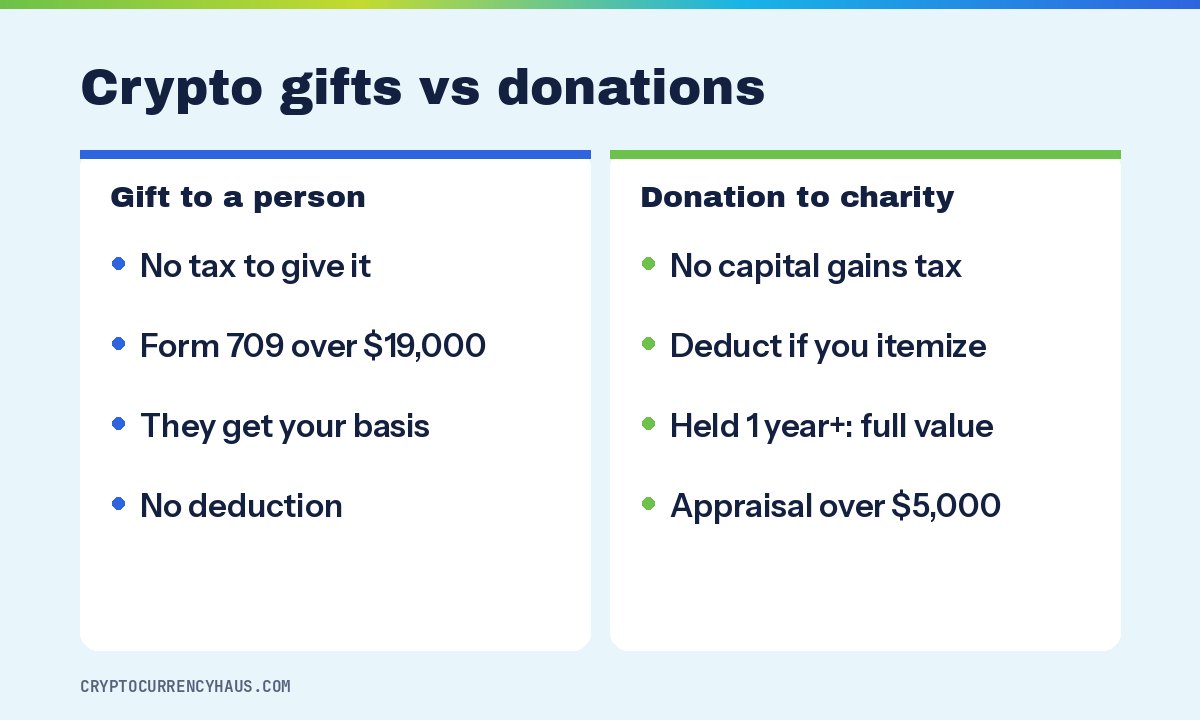
Quick answer: No. In the US, giving crypto as a gift isn’t a taxable sale, and the person who receives it owes nothing until they sell. In 2026 you can give up to $19,000 per person without filing a gift tax return. Above that you file Form 709, but you almost never owe gift tax. Donating crypto held over a year to a qualified charity avoids capital gains tax and can be deducted at its full market value if you itemize.
IRS rules and 2026 amounts on this page were checked on November 11, 2026 against IRS Revenue Procedure 2025-32, the IRS virtual currency FAQs, the 2026 Form 1040-ES and the Form 709 instructions. This is education, not tax advice. For large gifts, gifts to minors or estate planning, talk to a CPA or estate attorney.
Is gifting crypto taxable for the person giving it?
Not as income, and not as a capital gain. A sale needs something in return: dollars, another coin, a product. A true gift gets you nothing back, so there’s no gain to tax, even if your Bitcoin has gone up ten times since you bought it.
That only works if you give the crypto itself. Sell your coins and hand over the cash, and you’ve made a taxable sale first. The same is true if you swap your coin for a different one to give away. Our guide to how to report crypto on taxes covers what a sale costs you.
Two small things still apply to the giver. First, if the network fee for sending the gift is paid in crypto, the IRS treats that fee as a disposal of digital assets. It’s usually a tiny amount, but it belongs on your return. Second, on your Form 1040 you answer “Yes” to the digital asset question, because you transferred ownership of a digital asset.
How much crypto can you gift tax-free in 2026?
Two limits matter, and only one of them is something most people ever hit.
| 2026 amount | What it means |
|---|---|
| $19,000 per person | Annual exclusion. Give up to this much to each person, no form needed |
| Form 709 | Required if one person gets more than $19,000 from you in a year |
| $15,000,000 | Lifetime exemption. Gifts over the annual limit use it up before any gift tax is due |
| $194,000 | Annual exclusion for gifts to a spouse who isn’t a US citizen |
The $19,000 is per recipient. You could give $19,000 of Ether to each of three children in 2026 and file nothing. Gifts to a spouse who is a US citizen are generally unlimited.
Cross the line and you file Form 709 with your tax return. Filing doesn’t mean paying. The extra amount is subtracted from your $15 million lifetime exemption, and gift tax is only due once you’ve given away more than that over your whole life.
Watch out for the couples shortcut. Some guides say married couples can give $38,000 to one person “without Form 709” by splitting the gift. The IRS instructions say the opposite: you must file a gift tax return to split gifts with your spouse, whatever the amount. And at least one top-ranking guide still uses the 2023 limit of $17,000.
Value the gift in dollars on the day you give it, using a reliable price source. Save a screenshot or export of that price with the transfer record.
Do you pay tax on crypto you received as a gift?
Not when you receive it. The IRS says a bona fide gift of crypto isn’t income to you. You owe tax later, when you sell, swap or spend it, and the amount depends on the giver’s numbers, not just the value on the day you got it.
Here are the IRS rules from its virtual currency FAQs, in plain English:
- Your cost basis is the giver’s cost basis (plus any gift tax they paid). If your aunt paid $1,000 for the Bitcoin, so did you, for tax purposes.
- Your holding period includes theirs. If she held it for three years, your gain is already long-term the day you receive it.
- No records means zero basis. If you can’t document what the giver paid, the IRS says your basis is zero, and the whole sale price becomes taxable gain. Without proof of their holding period, yours starts the day after you receive it.
- Losses use a different number. For a loss, your basis is the lower of the giver’s cost or the market value on the day of the gift. This is the “dual basis” rule.
An example with real numbers
Sam bought Bitcoin for $1,000 in 2023 and gives it to her nephew in December 2026, when it’s worth $5,000. That’s under $19,000, so Sam files no Form 709 and owes nothing on the gift.
Her nephew sells it in 2027 for $6,000. His basis is Sam’s $1,000, and his holding period started in 2023, so he reports a $5,000 long-term capital gain. Sam’s gain didn’t disappear. It moved to him.
Now flip it. Say the coin had fallen to $800 by the gift date. If the nephew later sells for $700, his basis for a loss is $800 (the lower number), so his loss is $100, not $300. Sell for $900 and he reports no gain and no loss, because $900 sits between the two basis figures.
That last case points to a useful rule of thumb: don’t gift crypto that’s down. Sell it yourself, claim the loss on your own return and give the cash. Our guide to crypto tax-loss harvesting explains how to use that loss before December 31.
Is donating crypto to charity tax-deductible?
Yes, if the charity is a qualified organization (a 501(c)(3) public charity, for most people) and you itemize. A gift to a person is never deductible. A donation to a charity can be, and it comes with a second benefit: the IRS says you don’t recognize any gain when you donate crypto to a qualified charity.
How much you deduct depends on how long you held the coin:
- Held more than one year: you generally deduct the full fair market value on the day you donate.
- Held one year or less: you deduct the lower of what you paid or the market value.
Deductions for appreciated property given to public charities are generally capped at 30% of your adjusted gross income, with any extra carried forward for up to five years. Gifts to private foundations follow tighter rules, so get advice before using one.
Should you donate crypto or sell it and donate cash?
For coins that have gone up and that you’ve held more than a year, donating the crypto directly usually wins. Take the same $5,000 of Bitcoin bought for $1,000:
| Donate the Bitcoin | Sell, then donate cash | |
|---|---|---|
| Capital gain you report | $0 | $4,000 |
| Tax on the gain at 15% | $0 | $600 |
| Charity receives | $5,000 | $5,000 |
| Deduction if you itemize | $5,000 | $5,000 |
Same gift, $600 less tax. For coins that are down, do the reverse: sell, take the loss and donate the cash.
What changed for donations in 2026
Two new rules start with 2026 returns, and both matter for crypto donors.
- A 0.5% floor for itemizers. You can only deduct charitable gifts above 0.5% of your adjusted gross income. With $80,000 of AGI, the first $400 of giving isn’t deductible that year (it carries forward).
- A deduction for people who don’t itemize, up to $1,000 ($2,000 for married couples filing jointly). It covers cash only. Donated crypto doesn’t qualify.
Be honest with yourself about itemizing. The 2026 standard deduction is $16,100 for single filers and $32,200 for married couples filing jointly. If your mortgage interest, state taxes and giving don’t add up to more than that, a crypto donation still avoids capital gains tax, but the deduction itself won’t lower your bill.
What paperwork do crypto gifts and donations need?
- Gift of $19,000 or less to one person: no gift tax return. Keep a record of the date, amount, dollar value and your cost, and give a copy to the recipient.
- Gift over $19,000 to one person, or any split gift: file Form 709 by your tax return due date.
- Any donation of $250 or more: get a written acknowledgment from the charity before you file.
- Donations over $500: file Form 8283 with your return.
- Donations over $5,000: get a qualified appraisal and have the charity sign Form 8283. The IRS says crypto isn’t a “publicly traded security” for this form, so an exchange price alone isn’t enough.
The appraisal rule surprises a lot of people. Budget for it, or keep each year’s crypto donations at or under $5,000 unless the tax savings clearly cover the appraiser’s fee.
How to gift or donate crypto without mistakes
- Pick coins you’ve held more than a year and that are worth more than you paid. Skip coins that are down.
- Write down what you paid: purchase date, price, fees and where you bought it. Tax software such as Koinly can pull this from your exchange history.
- Get the right address. For a person, have them send you a receiving address from their own wallet or exchange account, and send a small test amount first. For a charity, use the address or crypto donation page linked from its official website, never one sent by email or text.
- Send it before December 31 if you want it to count for 2026. A donation counts in the year it’s delivered.
- Save proof: the transaction ID, the dollar value at the time, and the charity’s acknowledgment.
Crypto sent to the wrong address is gone. No bank can reverse it. Fake charities also show up after disasters and at year-end, asking for crypto because it can’t be clawed back. Check the charity on the IRS Tax Exempt Organization Search before sending, and read our guide to Bitcoin scams.
The bottom line
- Giving to family or friends: gift the crypto itself, stay at or under $19,000 per person if you can, and hand over your purchase records so they don’t pay tax on a zero basis.
- Giving to charity and you itemize: donate appreciated coins you’ve held over a year. You skip the capital gains tax and deduct the full value.
- Giving to charity and you don’t itemize: donating crypto still avoids capital gains tax, but only cash gifts count toward the new $1,000 deduction.
- Your crypto is down: sell it, use the loss and give cash instead.
The hard part of every gift is the record of what you paid. If your history is spread across exchanges and wallets, a tax app is the quickest way to get that number right before you give.

Koinly: find the cost basis and holding period of every coin
- Imports exchange and wallet history in one place
- Shows what you paid and how long you’ve held each coin
- Tracks gifts and donations so your tax reports stay right
Free to import and preview. You pay to download tax reports. Affiliate link.
Frequently asked questions
Do I have to report a crypto gift to the IRS?
Only if you give one person more than $19,000 in 2026, or split a gift with your spouse. Then you file Form 709. Smaller gifts need no gift tax return, though you still answer “Yes” to the digital asset question on Form 1040.
Do I pay taxes on crypto someone gave me?
Not when you receive it. You pay capital gains tax when you sell or swap it, using the giver’s original cost as your basis and counting their holding period.
What if the giver doesn’t know what they paid?
The IRS says your basis is zero if you can’t document the giver’s basis, so the whole sale price is taxable gain. Ask for exchange records or wallet history before you sell.
Can I gift crypto to avoid paying taxes?
Gifting moves the gain to the recipient rather than erasing it, so they pay when they sell. Donating to a qualified charity is different: neither you nor the charity pays tax on the gain.
Is sending crypto to my own wallet a gift?
No. Moving crypto between wallets or accounts you own isn’t a gift or a sale. Only a network fee paid in crypto counts as a disposal.
Do I need an appraisal to donate crypto?
Yes, if you claim a deduction of more than $5,000. The IRS doesn’t treat crypto as a publicly traded security for Form 8283, so a qualified appraisal is required above that amount.
How we researched this guide
On November 11, 2026 we read IRS Revenue Procedure 2025-32, the IRS virtual currency FAQs, the 2026 Form 1040-ES, the Form 709, Form 8283 and Form 1040 instructions, Publication 526 and IRS Chief Counsel Advice 202302012. Then we read the top-ranking guides on gifting and donating crypto and checked them against those sources. One still uses the 2023 gift limit, and another says couples can split gifts without filing Form 709. Partners can’t pay for our rankings. Read our review process.
Sources
- IRS Revenue Procedure 2025-32 ($19,000 annual exclusion, $15,000,000 exemption, 2026 standard deduction; checked November 2026)
- IRS: Frequently asked questions on virtual currency transactions (Q31 to Q36, gifts and donations; checked November 2026)
- IRS: Digital assets (Form 1040 question, transfer fees; checked November 2026)
- IRS: Instructions for Form 709 (who must file, gift splitting; checked November 2026)
- IRS: 2026 Form 1040-ES (0.5% floor, non-itemizer deduction; checked November 2026)
- IRS: Working Families Tax Cuts provisions (non-itemizer deduction is cash only; checked November 2026)
- IRS Publication 526 (charitable deduction limits, Form 8283, digital assets; checked November 2026)
- IRS: Instructions for Form 8283 (checked November 2026)
- IRS Chief Counsel Advice 202302012 (qualified appraisal for crypto donations over $5,000; checked November 2026)